DAX-and-DJI Technical Analysis:
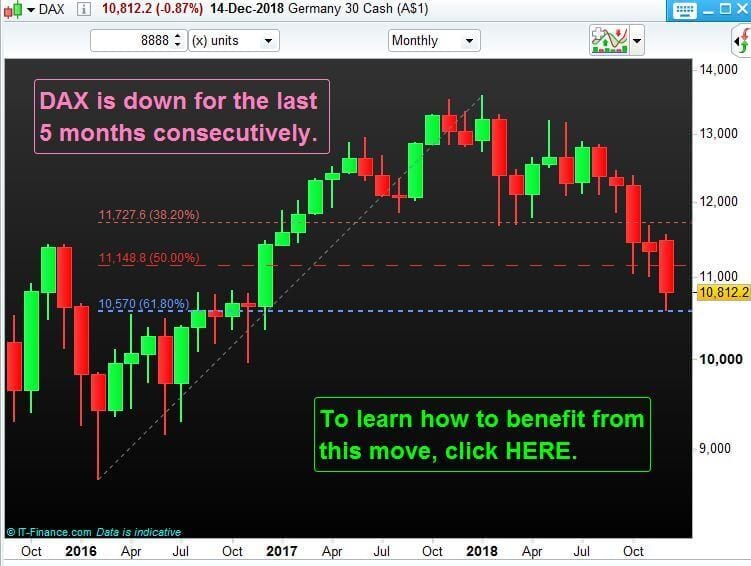
Germany 30 Stock market index (DAX) is down since last 5 months as shown below. As can be observed from the below chart for Germany 30 Stock market index (DAX), DAX is printing bearish (close price is below open price) candles for the last 5 months consecutively.
We have drawn the Fibonacci for Germany 30 Stock market index (DAX) monthly chart from the swing low of February 2016 (which was a “Hammer” bottom reversal Candle) to the swing high of January 2018. From that Fibonacci, it can be observed that the Germany 30 Stock market index (DAX) has crossed the 38.2% and 50% levels. Price of DAX has touched the 61.8% Fibonacci level as shown in the chart. It would be interesting to observe whether the price of DAX is also breaking this 61.8% Fibonacci level or not.
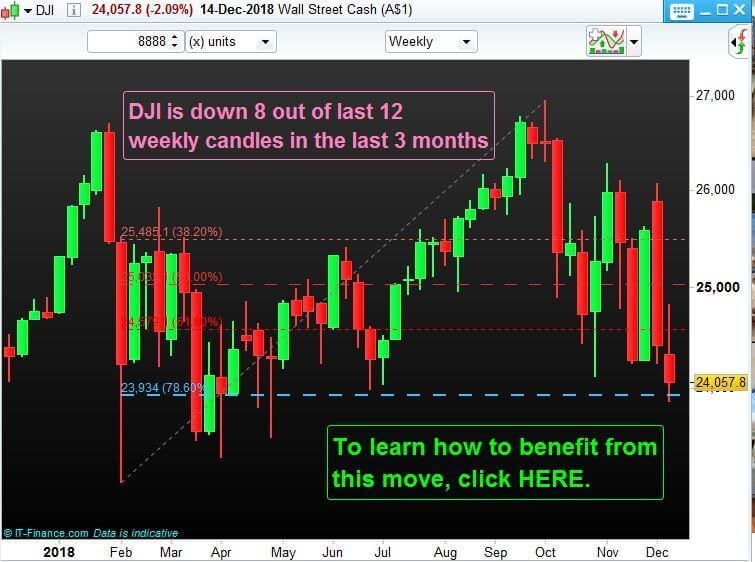
Similar to DAX, Wall Street Cash 30 Stock market index (DJI) is also down from 26,951 since October 2018 as shown below. As can be observed from the below chart for Wall Street Cash 30 Stock market index (DJI), DJI is printing bearish (close price is below open price) 8 out of last 12 weekly candles in the last 3 months, Similar to DAX.
Similar to DAX, we have drawn the Fibonacci for Wall Street Cash 30 Stock market index (DJI) weekly chart from the swing low of 5th of February 2018 to the swing high of 1st October 2018. From that Fibonacci, it can be observed that the Wall Street Cash 30 Stock market index (DJI) has crossed the 38.2%, 50% and 61.8% levels. Price of DJI has touched the 78.6% Fibonacci level as shown in the chart. It would be interesting to observe whether the price of DJI is also breaking this 78.6% Fibonacci level or not.
We are observing a lot of technical signals which are pointing to a possible start of a BEAR Market in Stock and Index Trading. We only analyze the situation as it is happening NOW in the world stock marketplace which can effect Index Trading worldwide in a big way.
We have analyzed three long-term time frames for two best indices viz. DJI 30 (Dow Jones 30 or Wall Street Cash) and DAX 30 (Germany 30 Cash) for Index Trading as shown below. The time frames we have analyzed are as below:
- Yearly,
- Quarterly and
- Monthly.
Dow Jones 30 or Wall Street Cash Index Market Analysis:
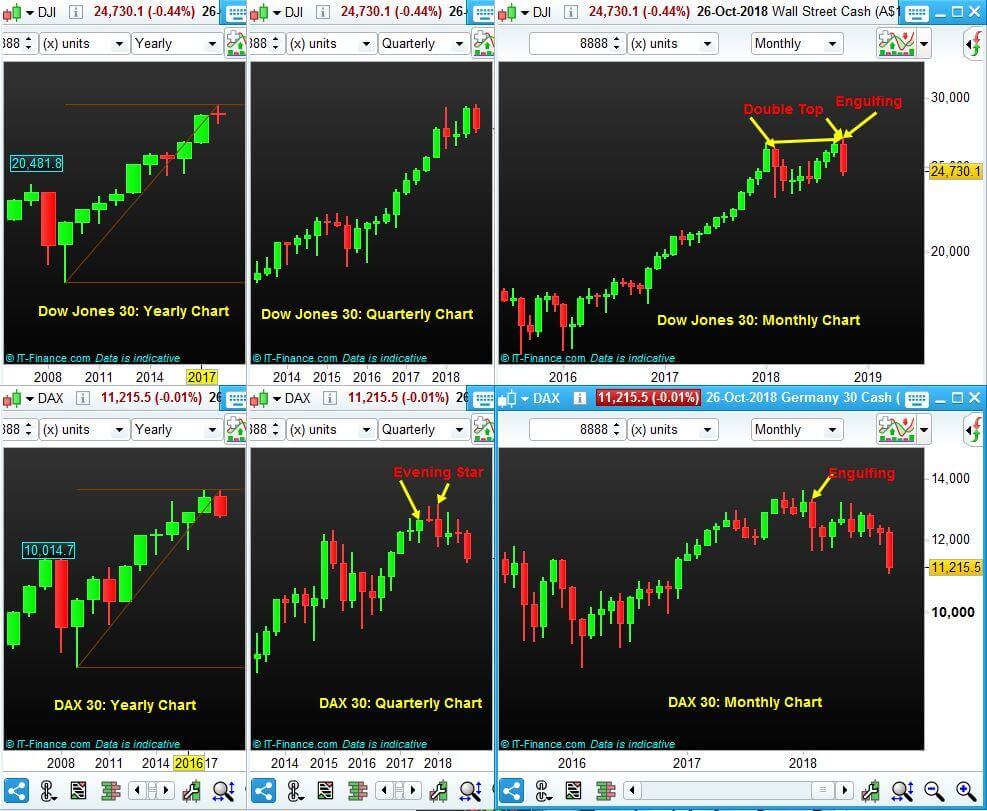
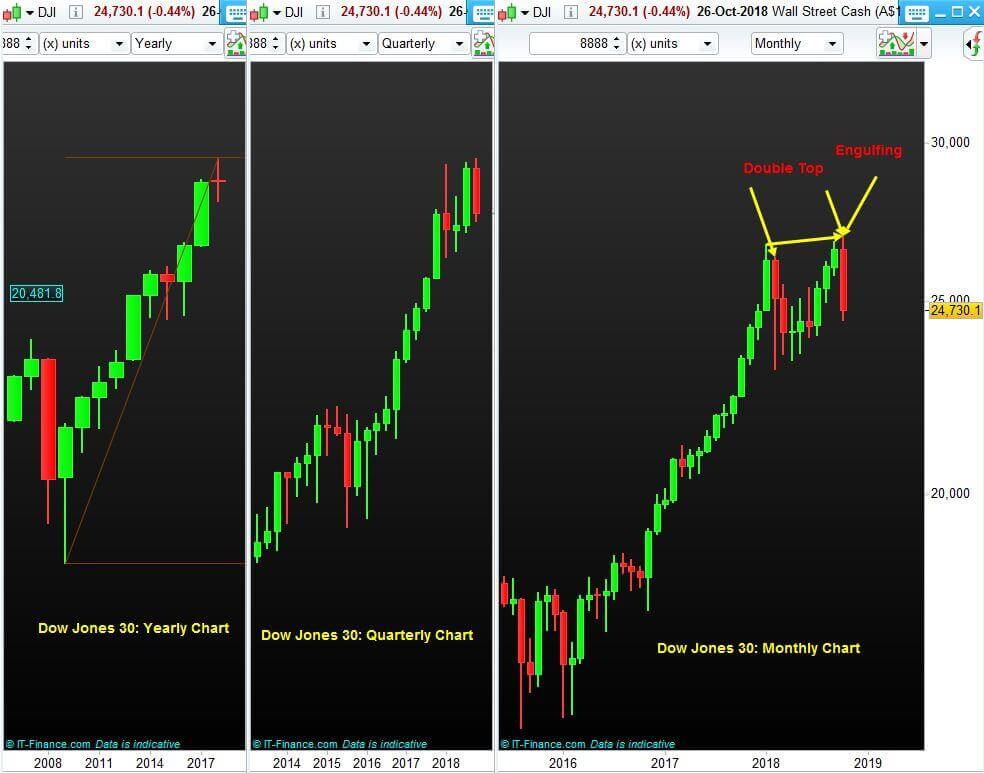
In the Yearly chart for Dow Jones 30, we can observe that this index market has moved up continuously from 2008 till 2018, in a bull market, a total of 20,481 points. The last candle which is forming for this year is shaping up like a “Doji” candle. Doji represents indecision, especially after a long run which happened for this Index Trading market.
In the Quarterly chart for Dow Jones 30 Index Trading, the last candle which is forming and will finish in the month of December is shaping up like a “Dark Cloud Cover” or “Engulfing”.
An almost similar situation for Dow Jones 30 Index Trading in the monthly chart can be observed. The last candle which is forming and will finish in the month of October within the next 3 days is shaping up like an “Engulfing”. We can also see the formation of a Double Top in this chart as shown below.
DAX 30 or Germany 30 Cash Index Market Analysis:
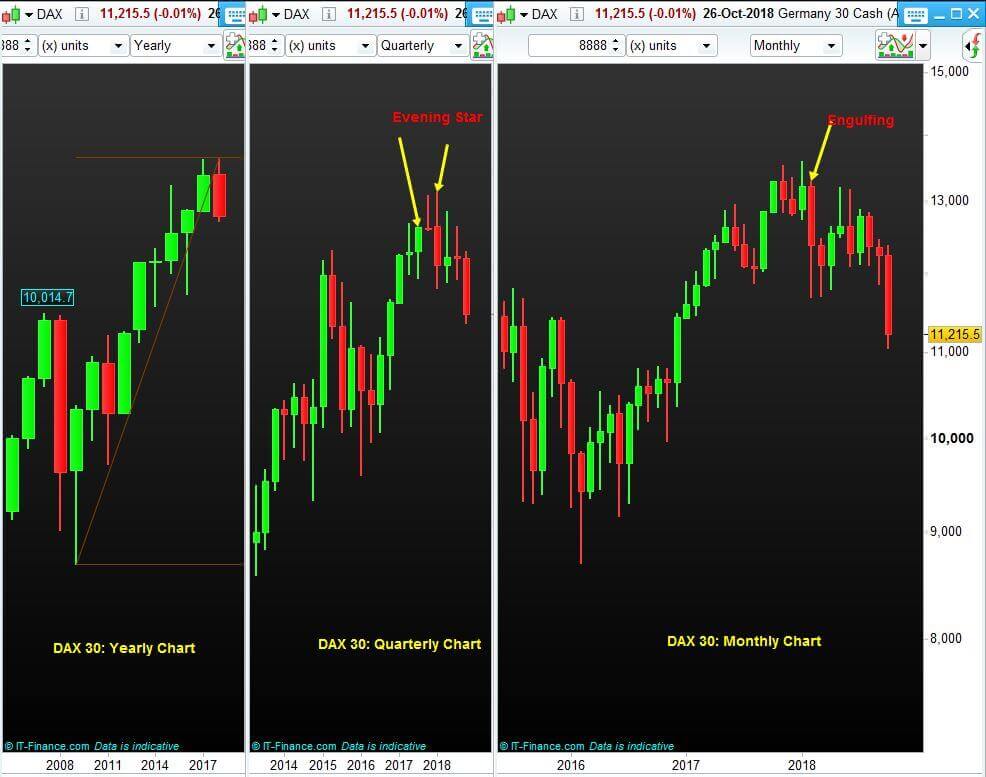
In the Yearly chart for DAX 30, we can observe that this index market has moved up continuously from 2008 till 2018, in a bull market, a total of 10,014 points. The last candle which is forming for this year is shaping up like an “Engulfing” candle. Bearish Engulfing represents a possible downturn, especially after a long run which happened for this Index Trading market.
In the Quarterly chart for DAX 30 Index Trading, this index trading market has already printed an “Evening Star” in the quarters of July 2017 to March 2018. Evening Start represents a possible downturn, especially after a long run which happened for this Index Trading market.
A similar weakness has already formed for DAX 30 Index Trading in the monthly chart which can be observed below. This market has already printed a bearish Engulfing in the month of February 2018 whose low is being taken out for the first time in the current month as shown below.
To take advantage of these new turning points in the worldwide index trading markets, click here.
Our Unique, Proprietary and most accurate Trader Foundation Course has the capability to identify these market turning points at a regular interval which we share with our Paid Clients.
When you are trained by us and learn how to trade Stock Markets Indices by taking advantage of our Knowledge and Expertise in the field, you can be benefited on a regular basis in Stock Markets Indices like Australia 200 (ASX200), China 50 (CHINA50), Hang Seng cash (HK50), Nikkei 225 cash (JP225), France 40 cash (CAC40), Germany 30 cash (DAX30), UK 100 cash (FTSE100), Wall Street 30 cash (WS30) and US SPX 500 cash (US500).
With our Proprietary Trader Foundation Course for Stock Markets Indices like the DJI 30 or DAX 30 Index markets, you can be benefited on a regular basis on DJI 30 or DAX 30 and other Stock Market Indices.
To Trade Stock Markets Indices in the Professional way and to find out the answers to all your Indices Trading related queries, please contact us at 03 9566 7275 and book your FREE discussion session for 30 minutes at Level 3, 2 Brandon Park Drive, Wheelers Hill, Victoria 3150.
We will not only handhold and guide you in the following aspects of the Professional way of Stock Markets Indices Trading but also will actually show you how we Trade Index CFDs for a living:
- Introduction to Trading Different Markets
- Index Market Facts, Timings, and its Framework
- How to take advantage from major Market Participants
- Index Trading Nomenclature
- The relationship between Worldwide Indices
- Dow Jones 30 vs.US Dollar Index
- Swaps, Spread, Slippage
- Fundamentals factors moving Markets
- Order Types, Leverage, Margin
- Trade Risk, Trade Reward, Favorable Reward to Risk
- Account Risk, Basic Position Sizing
- Introduction to Technical Trading
- Index Market Structure
- Market Mechanics and Dynamics
- Market Mapping
- Advance Trade Sizing
- How to identify in advance Market Reversals
- How to evaluate new price action before it unfolds
- Our own proprietary Bar by Bar Market Analysis
- You will come to know What to do & what not to do when
- Our proprietary Money & Risk Management Strategies
- Capital and Portfolio Management System
- Performance Analysis of Bar by Bar Market Analysis
- Professional Trader Mindset including Major Mistakes to be avoided
Now you can trade Stock Markets Indices with us to explore the possibility of earning passive income keeping your day job.
Our Proprietary Stock Markets Indices Trading Strategies will guide you through every step of your trading in Shares and explore the possibility of earning extra income.
Learn what all other national and international Stock Markets Indices we are Trading in our Index Trading Asset Class.
Develop yourself as a professional trader capable of capturing second income in the future with us.
Become a Member to grab these Market Sync based Stock Markets Indices Trading Opportunities in the future by clicking here.
Please click on the Contact Us link: Goo.Gl/2SRZoG
Call us on +61 3 9566 7275
email: [email protected]
Learn Share Trading with Partha Banerjee of N P Financials, the Prop Trading Firm at Melbourne
Learn how to Trade the Directional Share Market. Get mentored in the art and science of Share Trading in our proprietary 6 months developmental course. Derive benefit from our effective Share Trading Strategies.
On completion of the “Basics of Trading” course, You will develop an In-depth understanding of Fundamentals factors moving Markets. You will be able to clearly understand the Market Jargon e.g. Swaps, Spread, Slippage etc.
A full-time professional trader from N P Financials will be your own personal coach for 3-6 months. You will be trained on how to learn the Market Programming Language.
A full-time professional trader from NPF will be your own personal coach for 3-6 months. You will be trained on how to Develop your Market Scanning Edge.
Develop your own Trading System e.g. Stock CFD Trading with Partha Banerjee of N P Financials, the Prop Trading Firm at Melbourne
A full-time professional trader from NPF will be your own personal coach for 3-6 months. You will be trained on how to Build your Trading Edge e.g. Stock CFD Trading
.