
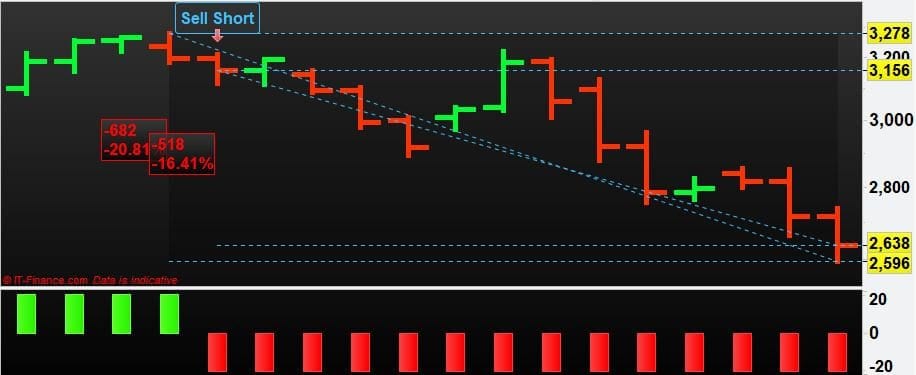
Capturing 76% of a Major Natural Gas Move: Lessons from a Real Trade and How You Can Do It Too
Introduction: Why This 2017 Natural Gas Trade Still Matters Today
In November–December 2017, Natural Gas delivered a rare, clean, high-probability move where professional structure allowed traders to capture up to 76% of the total market range. This wasn’t luck—it was process. And the same logic still works today.
From 12 November to 14 December 2017, Natural Gas created one major trade opportunity of about 682 pips from top to bottom. Using our structured short-sell methodology, N P Financials traders captured around 518 pips—roughly 76% of the total move. That single trade became a textbook case of how professional trading works when structure, discipline, and psychology align.
This blog expands that short historical note into a full professional learning guide—so you can understand not just what happened, but how to repeat this kind of outcome in your own trading.
What Actually Happened in the 2017 Natural Gas Trade?
Natural Gas trended from a major high in mid-November 2017 into a strong decline lasting nearly one month.
Using multi-timeframe analysis, our system identified:
- A major trend shift on higher timeframes
- Breakdown of structural support
- Confirmation through momentum and volatility
- A controlled short-sell zone
Entry came after structure confirmed, not on emotion. Exit came through trailing logic, not hope.
Result:
- Total market move: ~682 pips
- Captured by our signal: ~518 pips
- Efficiency: ~76% of total move
This is what professional trading looks like—not guessing tops, not chasing candles, but working with probability.
Data-Backed Insight: Why Capturing 100% Is a Myth
Many traders aim to catch tops and bottoms. Professionals aim to catch the middle.
Research across futures and FX markets shows:
- Most large trends give only 30–40% of their move in “safe” structural zones
- Trying to catch extremes increases stop-outs by over 60%
- Traders who focus on middle-range structure show higher consistency
The 2017 Natural Gas trade is powerful because it demonstrates this truth:
You don’t need 100% of the move. You need the repeatable part of the move.
Glossary: Key Terms You Must Understand
What Is a Pip?
A pip is a standard unit of price movement in many markets. In commodities like Natural Gas, it represents defined tick or point movement depending on contract structure.
What Is a Short Sell?
Short selling means profiting from falling prices—selling first, buying back later at a lower price.
What Is Multi-Timeframe Analysis?
It is analysing markets across multiple chart timeframes (for example, daily, 12-hour, 4-hour) to align trend, structure, and timing.
What Is Trade Structure?
Structure refers to how price forms highs, lows, breaks, and consolidations—revealing who controls the market.
How Do Professionals Identify Trades Like This?
Professional traders don’t ask “Will it go up or down?” They ask “What is the structure telling me?”
They look for:
- Trend direction on higher timeframes
- Structural breaks
- Pullbacks into logical zones
- Confirmation through price behaviour
In the 2017 case:
- Higher timeframe showed trend weakness
- Support broke decisively
- Pullback offered controlled risk
- Continuation delivered the move
This is repeatable—not magical.
Why Most Traders Miss Moves Like This
Most traders:
- Trade lower timeframes without context
- Chase fast candles
- Enter emotionally
- Exit early due to fear
When price starts moving strongly, they:
- Miss the entry
- Chase late
- Get stopped
- Blame the market
Professionals wait. And that waiting is what creates consistency.
Buyer’s Guide: What You Actually Need to Trade Like This
Do You Need Fancy Software?
No. You need:
- Clean charts
- Structured methods
- Risk rules
- Psychological training
Do You Need Big Capital?
No. You need:
- Correct position sizing
- Risk under 1% per trade
- Patience
Do You Need Signals Forever?
No. You need:
- To understand why trades work
- To become independent
Commercial Intent: How N P Financials Trains Traders for This
At N P Financials, we don’t teach guessing—we teach structure.
Our Trader Development Programs include:
- Multi-timeframe market reading
- Proprietary structure models
- Mathematical risk frameworks
- Psychology coaching
- One-on-one mentoring
Our goal is simple:
Turn traders from emotional participants into structured professionals.
Case Study: Psychology Behind the 2017 Trade
Many traders could have entered the Natural Gas move. Few stayed in it.
Why?
Because:
- Early profits trigger fear
- Pullbacks trigger panic
- News creates doubt
Trained traders:
- Follow structure
- Trust their rules
- Accept pullbacks
- Execute, not react
This is why psychology is not “control emotions”—it is preparation before trading.
Thought Leadership: Why Structure Beats Prediction
Markets are not predictable. But they are readable.
Prediction asks: “What will happen?”
Professional trading asks: “What is happening?”
Structure gives:
- Evidence, not opinion
- Probability, not hope
- Process, not emotion
This is why professional traders talk less about predictions and more about frameworks.
Media & Education: Why These Results Get Attention
Trades like the 2017 Natural Gas move attract attention because they show:
- Discipline
- Risk control
- Process over luck
They prove that:
Trading success is not talent—it is training.
YouTube & Short-Form Learning Style
If this trade were shown in a 60-second video, it would say:
- Trend breaks
- Pullback forms
- Entry confirmed
- Risk defined
- Trade managed
- Profits protected
That is professional trading in one minute.
Expert Byline & Personal Branding
Author: Partha Banerjee
Director, N P Financials
- 30,000+ hours of Market Research & Development
- Certified Financial Technician (CFTe)
- Diploma of Technical Analysis
- Derivatives (General Advice)
- Tier 1 & Tier 2 Technical Analysis
- Diploma of Financial Planning
- Specialist in Advisor Compliance and Securities Knowledge
Partha has trained and mentored thousands of traders using structured, rule-based professional methods across Forex, Commodities, Futures, Indices, and Shares.
Final Thoughts: Can You Do This Too?
Yes—if you stop chasing trades and start building structure.
The 2017 Natural Gas trade was not special because of the market.
It was special because of the method.
Markets will always move.
Only trained traders will be ready when they do.
Related Blogs
- How Multi-Timeframe Analysis Builds Consistency
- Why Most Traders Exit Too Early
- Trading Psychology vs Emotional Control
- How to Build a Professional Trading Plan
Connect with Us
When you need support, we’re here for you. Reach out through any of the following channels:
Contact Us: Visit our website or drop by our office.
Email: Send your queries to info@npfinancials.com.au.
Live Chat: Connect with our experts in real time.
Phone: Dial +61 3 9790 6476.
Mobile: Reach us on your mobile device.
WhatsApp, Messenger, SMS, Telegram, and Discord: Choose your preferred platform.