Australia’s Economic Tightrope: Inflation, Productivity, and the Policy Tightrope Walk.
Introduction:
On Tuesday the 6th of February, Michelle Bullock made her first press conference which addressed the reasons in which Australia left its cash rate unchanged at 4.35%.
The main focus for the rate decision was inflation and productivity.
She stated many times in the conference that she would not rule anything in or out in regards to a rate hike or cut in the future and that the country is in a narrow band heading towards a more ” normalised ” economy.
Was it a prudent pause or a missed opportunity to address simmering inflation concerns? Michelle Bullock’s press conference provided glimpses into the RBA’s thinking, but questions abound: What path lies ahead for Australian economic policy, and how can we navigate the complex challenges at hand?
Let’s delve deeper into the key themes underpinning the decision: inflation, productivity, and the precarious balance the RBA is facing.
Inflation: From Peak Panic to Plateau Peril?
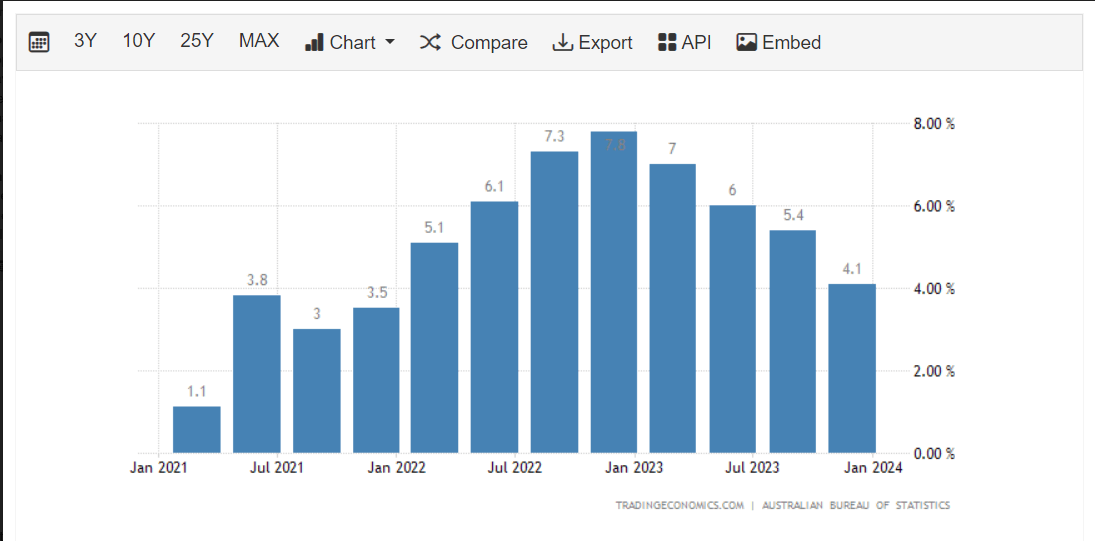
Inflation, once a menacing beast clawing at 7.8% in January 2023, has retreated to a (somewhat) tamer 4.1%. This decline offers a sigh of relief, but Governor Bullock’s caution against premature victory serves as a stark reminder that the battle is far from over. External pressures like volatile oil prices and ongoing global supply chain disruptions continue to cast a shadow, threatening to reignite inflationary flames.
Inflation has been steadily dropping each quarter from its peak in January 2023 of 7.8% down to a now 4.1% , Albeit still high Miss Bullock did address the fact there was still a 4 in front of the number.
However, the domestic scene adds another layer of complexity. The Australian housing market, fuelled by foreign investment and immigration, has become a poster child for global affordability woes. While it translates to a potential economic boon, concerns about a bubble and its inflationary consequences linger.
RBA policymakers must walk a tightrope, ensuring affordability without igniting another price spiral. This might involve targeted measures like macroprudential policies to address specific segments of the market, rather than blunt-force instruments like broad interest rate increases.
Additionally, investigating potential anti-competitive practices within the housing industry could help address affordability concerns.
Beyond the Housing Market: Inflation’s Wider Reach
Lets not forget due to all the foreign investment allowed in this country and the immigration both which now has fuelled Australia’s enormous property growth. to have multiple entries in the top 10 of the most un affordable places to buy real estate in the world.
May we ask the politicians to give up their property portfolios so they might actually care for you ? Do you think there is a personal influence to why they want to keep inflation high and to keep housing unaffordable for their personal growth or do they actually care about the people’s poor quality of life ? I will let you decide.
The stage 3 tax cuts coming out this year are also there to benefit property portfolio holders, Go figure. This all affects inflation.
While the housing market captures much attention, inflation isn’t limited to that sector. Rising grocery prices, energy costs, and transportation expenses continue to pinch household budgets.
The RBA must consider the diverse factors contributing to inflation and tailor its responses accordingly. This might involve collaborating with other government agencies to address supply chain bottlenecks or investigating potential price gouging in specific sectors.
Additionally, targeted fiscal measures that support lower-income households could help mitigate the distributional effects of inflation.
Productivity: Myth or Missing Key?
In regards to productivity and unemployment. let’s keep in mind all the immigration which is happening. The immigrants on arrival will not have a job in which they will need to look for work.
Being from another country their familiarization of Australian standards required for their job will take time to acquire and there will be times when rework will need to done to complete certain projects, Skills will also need to trained to these people which don’t happen overnight so they might be out of the workforce for a little while before they can enter it and keep up with the current workforce hence slowed productivity.
Not only that, with so much immigration does not mean the country can keep generating new jobs, in short the population is growing faster than jobs available, making more people not being productive in the country. Another scary sight is how few jobs ( year on year ) are getting posted over the last year. How is this helping productivity? Less jobs but increased population ?
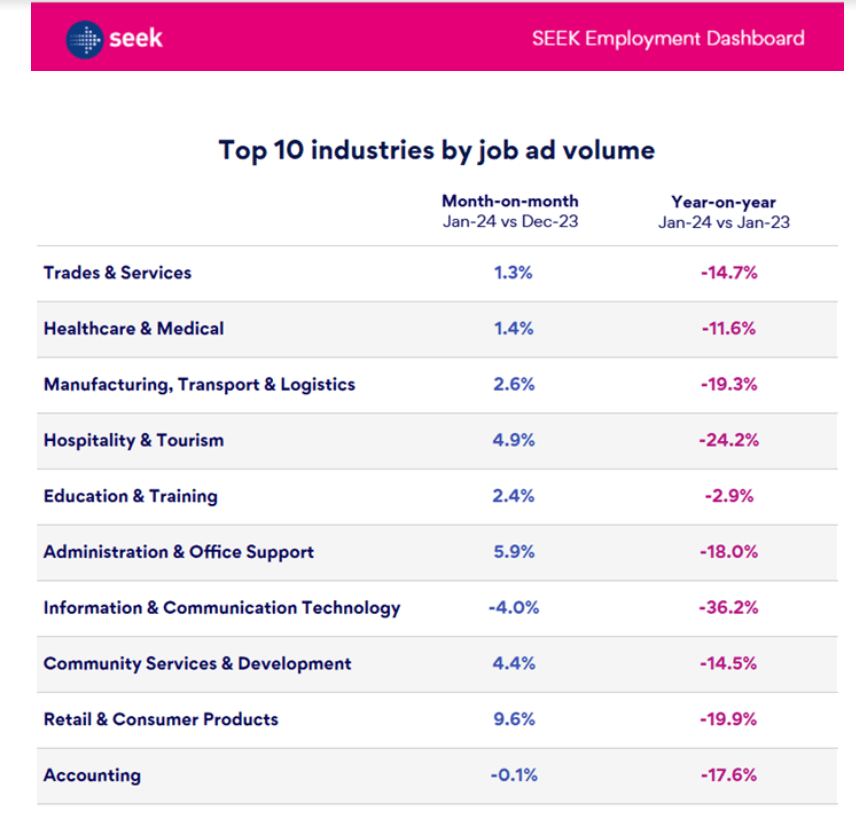
The post raises a potent question: is immigration a double-edged sword for productivity? While the influx of new talent undeniably expands the workforce, their initial integration period can lead to short-term dips in efficiency. Re-training, language barriers, and adapting to Australian work practices take time, potentially impacting productivity in the near term.
Yet, painting an overly simplistic picture would be disingenuous. Immigration also brings diverse skills and cultural perspectives, fostering innovation and long-term economic growth.
The key lies in effective integration programs and policies that bridge the gap between initial arrival and productive contribution. This includes language classes, cultural sensitivity training, and targeted vocational training programs tailored to specific skillsets and Australian industry needs. Additionally, investing in digitalization and upskilling programs for the existing workforce can further enhance overall productivity.
Stage 3 Tax Cuts: Boon or Bane for Productivity and Inflation?
The spectre of Stage 3 tax cuts looms large, raising eyebrows about their potential impact on both inflation and productivity. Proponents argue they will stimulate spending and economic activity, leading to increased productivity and economic growth.
Critics, however, fear they will exacerbate inflationary pressures and disproportionately benefit property investors, potentially widening the inequality gap.
The RBA finds itself in a complex position, needing to assess the competing narratives and their nuanced effects on both long-term and short-term economic goals.
Beyond simply analyzing the direct impact on inflation and productivity, the RBA must consider the distributional effects of the tax cuts. Will they exacerbate existing inequalities, or can they be designed to promote broader economic participation and investment?
This necessitates a thorough analysis of the potential economic and social consequences before moving forward. Additionally, exploring alternative fiscal policy options aimed at boosting productivity and addressing inequality could provide broader societal benefits.
Reserve Bank’s Approach and Market Speculations
What Michelle has directed everyone’s attention to for the making of the decision is quiet deceitful. She did say many times that the reserve bank will not rule anything in or anything out for a rate hike or cut and with the way she was holding back on any proper information or speculation with vague answers to questions and the unwillingness to put anything forward to the public it became clear that the reserve bank isn’t going to do anything until the Federal reserve does anything with their rates.
Bullock’s reserved stance on future rate adjustments hints at the Reserve Bank’s cautious approach, potentially influenced by global economic conditions.
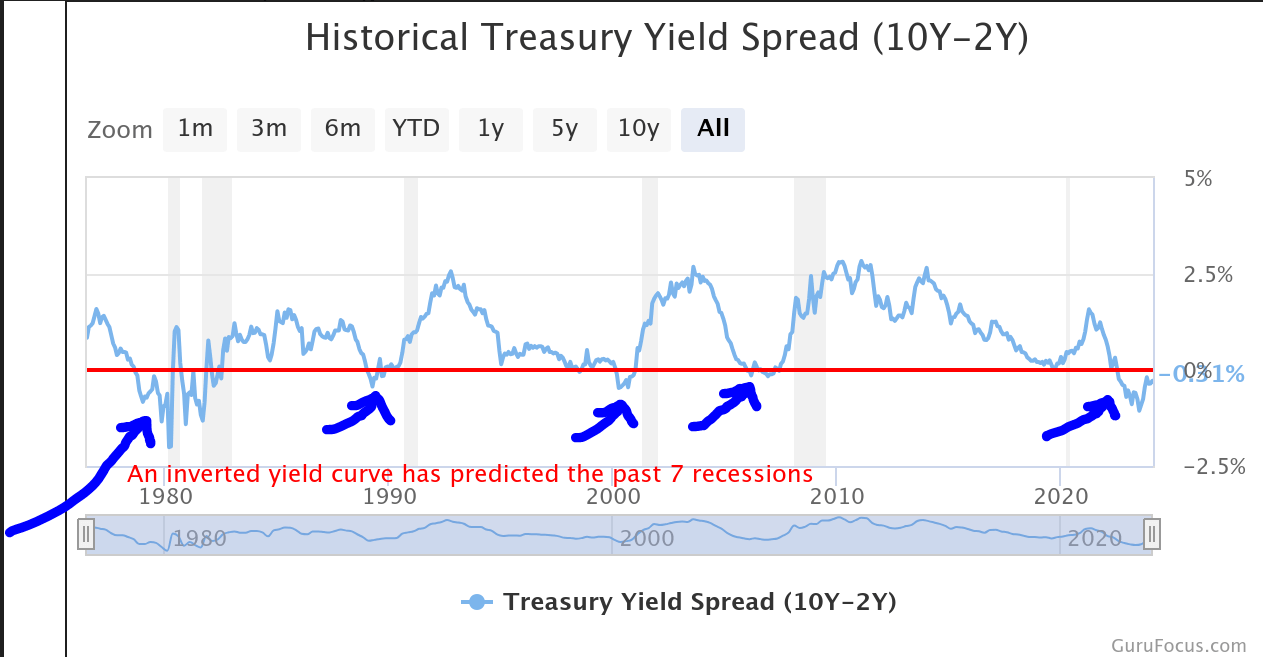
Speculations arise about the Reserve Bank’s synchronized action with the Federal Reserve’s rate adjustments, given the Treasury yield curve inversion and potential deflationary pressures.
Beyond Australia: The Global Monetary Symphony
At Least the FED has publicly announced a few times that they will be cutting rates at some point this year, It is worth mentioning that the Treasury yield curve has been inverted for over 400 day’s this This is what we can use to help us gauge a feel of what to anticipate for Australia later this year.
A Thought ” Fed cuts rates to 0 and deflationary recession ahead ” Will we feel the same markets ?
No domestic policy decision exists in a vacuum. Global monetary policy plays a crucial role in shaping Australia’s economic landscape. While the Federal Reserve hints at potential rate cuts later in the year, its future actions remain shrouded in uncertainty.
Additionally, the inverted Treasury yield curve, often seen as a recession indicator, adds another layer of complexity to the equation. RBA policymakers must carefully consider these external factors, anticipating potential ripples and adjusting their course accordingly. This might involve closer collaboration with international central banks.
Anticipating Economic Trends
The prospect of a near-zero Fed rate and a looming deflationary recession prompts reflections on potential market impacts and adjustments in Australia.
In summary, Bullock’s insights provide a nuanced understanding of Australia’s economic landscape, raising pertinent questions about policy directions and their implications for inflation, productivity, and market stability.
🌐 Sources
- RBA – Outlook
- RBA – Monetary Policy Decision
- The Guardian – RBA Interest Rates Announcement
- ABC News – RBA Keeps Interest Rates Steady
- RBA Official Website
N P Financials can be contacted at:
[email protected]
+61 3 9790 6476
N P Financials Pty Ltd
Level 3, 2 Brandon Park Drive
Wheelers Hill, Victoria 3150
=======================================================
Role of Proper Education in Forex Trading
We’ve seen first hand the impact of proper education in forex trading for last 10 years. It’s not just a matter of learning a few strategies or techniques; it’s about building a solid foundation of skills and knowledge that can lead to success in the market. Continuous learning and practice are essential in this ever-evolving industry.
As a novice trader, investing in forex courses and education was one of the best decisions you can make. Understanding the basics, from terminology to calculations, will give you the confidence to make informed trading decisions. But it doesn’t stop there. Knowledge of macroeconomics is crucial for interpreting market news and its impact on currency movements.
Building a trading strategy based on research and experience is key to consistent profitability. This is where mentoring and learning from successful traders can provide valuable insights and guidance. And with the convenience and flexibility of online courses, education is more accessible than ever.
Proper education plays a pivotal role in risk management, strategy development, technical analysis, and fundamental analysis. It minimizes the chances of failure and contributes to profitable transactions. Whether you’re a newcomer or a seasoned trader, ongoing education is invaluable in the forex market.
So, if you’re looking to enter the forex market, don’t underestimate the power of education. It can be the difference between struggling and thriving in this highly liquid and potentially profitable market. Start investing in your knowledge and skills today, and unlock the secrets to successful forex trading.
Key Takeaways
- Proper education is crucial for success in forex trading as it provides the necessary skills and knowledge.
- Novice traders should invest in forex courses and education to gain a solid foundation.
- Building a trading strategy based on research and experience is important for consistent profitability.
- Online courses can be a more affordable alternative to classroom courses, offering convenience and flexibility for learning.
- The synergy between education and online forex trading leads to confidence building, risk mitigation, strategy implementation, and continuous learning.
Importance of Proper Education in Forex Trading
Proper education is crucial for success in forex trading.
When it comes to forex trading, proper education is the key to success. Without the necessary skills and knowledge, navigating the complex world of forex can be overwhelming and risky. By investing in education, traders can gain a solid foundation and increase their chances of profitable transactions.
It provides the necessary skills and knowledge.
Forex trading is not something that can be mastered overnight. It requires continuous learning and practice to develop the skills needed to make informed trading decisions. Novice traders should consider investing in forex courses and education to gain a deep understanding of the market.
Understanding the basics of forex trading, including terminology and calculations, is essential for making informed trading decisions. Without this knowledge, traders may find themselves lost and unable to effectively analyse market trends and patterns.
Knowledge of macroeconomics is necessary to interpret macro news and its impact on the forex market.
In addition to understanding the technical aspects of forex trading, having knowledge of macroeconomics is crucial. Macroeconomic factors such as interest rates, GDP growth, and inflation can have a significant impact on currency values. Being able to interpret macro news and its potential impact on the forex market is essential for successful trading.
Building a trading strategy based on research and experience is important for consistent profitability.
A solid education in forex trading equips traders with the tools and knowledge to develop a trading strategy. By conducting thorough research and leveraging personal experience, traders can create a strategy that aligns with their goals and risk tolerance. A well-defined strategy increases the chances of consistent profitability in the forex market.
Learning from successful traders through mentoring can provide valuable insights and guidance.
One of the most effective ways to enhance forex trading skills is by learning from successful traders through mentoring. Mentors can provide valuable insights, guidance, and real-world experiences that textbooks cannot offer. By observing and emulating the strategies of successful traders, novice traders can accelerate their learning curve and avoid common pitfalls.
Online courses can be a more affordable alternative to classroom courses, offering convenience and flexibility for learning.
While traditional classroom courses are beneficial, online educational platforms have become increasingly popular in recent years. Online courses offer the convenience and flexibility of self-paced learning, allowing traders to study at their own pace. Moreover, online courses are often more affordable than their classroom counterparts, making education accessible to a wider audience.
Education plays a pivotal role in risk management, strategy development, technical analysis, and fundamental analysis in forex trading.
Education is the backbone of various crucial aspects of forex trading, including risk management, strategy development, technical analysis, and fundamental analysis. By understanding these core concepts, traders can minimize risks, develop effective strategies, and make informed trading decisions based on technical indicators and market trends.
Online forex trading platforms provide educational materials, demo accounts, expert analysis, trading courses, and community engagement to support trader education.
To further support trader education, online forex trading platforms offer a wealth of educational resources. These platforms provide access to educational materials, demo accounts for practice, expert analysis, trading courses, and community engagement. Such resources allow traders to continuously learn, refine their skills, and stay up-to-date with market trends.
The synergy between education and online forex trading leads to confidence building, risk mitigation, strategy implementation, and continuous learning.
The synergy between education and online forex trading is powerful. By combining the knowledge and skills gained through education with the practical experience of trading, traders can build confidence, mitigate risks, implement effective strategies, and engage in continuous learning. This synergy is essential for long-term success in the forex market.
Ongoing education is valuable for both newcomers and seasoned traders in the forex market.
Education should not be limited to novice traders. Even seasoned traders can benefit from ongoing education to stay ahead of the curve and adapt to changing market conditions. The forex market is constantly evolving, and staying updated through continuous education is crucial for sustained success.
Proper education minimizes the chances of failure and contributes to profitable transactions in forex trading.
Without proper education, the chances of failure in forex trading increase significantly. Education provides traders with the necessary tools, knowledge, and skills to navigate the market effectively and make profitable transactions. By investing in education, traders can minimize risks and increase their chances of success.
Forex trading allows anyone to start regardless of their experience and knowledge, making education even more important.
One of the unique aspects of forex trading is that anyone can start, regardless of their experience and knowledge. However, this accessibility also highlights the importance of education. Without proper education, traders may be at a disadvantage and struggle to navigate the complexities of the forex market.
Time flexibility is a benefit of forex trading as it operates in different time zones, allowing traders to participate at their convenience.
forex trading operates 22/5 across different time zones, providing traders with the flexibility to participate at their convenience. This time flexibility is a significant advantage, allowing individuals to engage in trading alongside their other commitments. However, it is important to note that proper education is still necessary to make informed trading decisions and succeed in the market.
The forex market is highly liquid and can be profitable with competent trading skills acquired through education.
The forex market is known for its high liquidity, which means there is a constant flow of buyers and sellers. With competent trading skills acquired through education, traders can take advantage of this liquidity and potentially profit from their trades. However, it is crucial to remember that education is the foundation for successful trading, as it equips traders with the necessary skills to navigate the market effectively.
Learning forex trading provides crucial secrets for success, enabling traders to navigate the market effectively.
Forex trading is not simply about luck or chance. It requires a deep understanding of market dynamics, technical analysis, and risk management. By learning forex trading, traders gain access to crucial secrets for success, enabling them to navigate the market effectively and make informed trading decisions.
Many traders struggle to enter the market without proper education, highlighting the importance of acquiring the necessary knowledge and skills.
It is not uncommon for traders to struggle when entering the forex market without proper education. The complexities of the market, coupled with the volatile nature of currency movements, can make it challenging to achieve success without the necessary knowledge and skills. Acquiring proper education is crucial for aspiring traders to avoid common pitfalls and increase their chances of success.
Continuous Learning and Practice in Forex Trading
Role of Proper Education in Forex Trading
Proper education plays a pivotal role in the success of forex trading. It provides traders with the necessary skills, knowledge, and confidence to navigate the dynamic and complex forex market. Forex trading requires continuous learning and practice to develop the expertise needed to make informed trading decisions and achieve consistent profitability.
Investing in Forex Courses and Education for a Solid Foundation
For novice traders, investing in forex courses and education is essential to lay a solid foundation. Our courses cover a wide range of topics, from the basics of forex trading, including terminology and calculations, to advanced strategies and market analysis techniques. By acquiring a comprehensive understanding of the forex market, traders can make more informed decisions and minimize the risks associated with trading.
Understanding Macroeconomics for Interpreting Market Impact
Knowledge of macroeconomics is crucial for interpreting macro news and its impact on the forex market. Economic indicators, such as GDP, inflation rates, and interest rates, can have a significant influence on currency values. Traders who understand the underlying economic principles can better anticipate market movements and adjust their trading strategies accordingly.
Building a Trading Strategy Based on Research and Experience
Our well-defined trading strategy is the backbone of successful forex trading. Our proper education equips traders with the tools and techniques to develop a trading strategy based on thorough research and experience. By analyzing historical data, identifying patterns, and testing strategies in simulated environments, traders can refine their approach and increase their chances of profitability.
Learning from Successful Traders through Mentoring
Mentoring is an invaluable resource for traders seeking to accelerate their learning curve and gain insights from experienced professionals. Learning from successful traders allows novices to understand their thought processes, decision-making strategies, and risk management techniques. N P Financials’ guidance can provide valuable shortcuts and prevent common mistakes, ultimately enhancing the trader’s overall performance.
Online Courses: Affordable and Convenient Learning Options
In today’s digital age, online forex trading courses offer a more affordable and convenient alternative to traditional classroom-based education. Our courses provide flexibility in terms of timing and location, allowing traders to learn at their own pace. Our online platforms often offer a variety of educational resources, including video tutorials, interactive quizzes, and forums for community engagement.
Education’s Role in Risk Management and Market Analysis
Proper education plays a pivotal role in risk management, strategy development, technical analysis, and fundamental analysis in forex trading. Traders who have received our comprehensive education are better equipped to identify and manage risks effectively. They can also analyse market trends, interpret charts, and leverage various technical indicators to make informed trading decisions.
Synergy between Education and Online Forex Trading
The synergy between education and online forex trading is undeniable. Online trading platforms provide educational materials, demo accounts, expert analysis, and trading courses to support trader education. This combination enables traders to implement their newly acquired knowledge in real-time market conditions, fostering confidence building, risk mitigation, and continuous learning.
Ongoing Education for Newcomers and Seasoned Traders
Education is not a one-time event but a continuous process in forex trading. Both newcomers and seasoned traders can benefit from ongoing education to stay updated with the latest market trends, strategies, and tools. The forex market is constantly evolving, and traders must adapt their skills and knowledge to remain competitive and profitable.
Minimizing Failure and Maximizing Profitability
Proper education minimizes the chances of failure and contributes to profitable transactions in forex trading. By understanding the intricacies of the market, traders can make well-informed decisions and avoid common pitfalls. N P Financials’ education provides the necessary foundation to navigate the complexities of the forex market successfully.
Empowering Traders of All Levels
One of the remarkable aspects of our forex trading is its accessibility. Anyone, regardless of their prior experience and knowledge, can enter the market and start trading. This further emphasizes the importance of education in forex trading. Whether you are a beginner or an experienced trader, continuous learning and practice are key to unlocking the full potential of forex trading.
In conclusion, proper education is crucial for success in forex trading. It equips traders with the necessary skills, knowledge, and confidence to navigate the market effectively. Continuous learning and practice, along with investing in forex courses and education, provide a solid foundation for traders to develop their strategies, interpret market trends, and maximize profitability. Education and online forex trading platforms together create a synergy that fosters continuous learning, risk mitigation, and strategy implementation. By prioritizing education, traders can minimize the chances of failure and increase their chances of success in the dynamic world of forex trading.
Role of Proper Education in Forex Trading
As someone who has been involved in forex trading for many years, I can confidently say that proper education plays a pivotal role in achieving success in this dynamic market. Forex trading requires continuous learning and practice to develop the necessary skills and knowledge. Novice traders, in particular, should invest in forex courses and education to gain a solid foundation.
The Basics: Understanding Forex Terminology and Calculations
To make informed trading decisions, it is essential to have a thorough understanding of the basics of forex trading. This includes familiarizing yourself with the terminology and calculations used in the market. Without this knowledge, it can be challenging to interpret the various indicators and charts that form the backbone of forex analysis.
Macroeconomics: Interpreting News Impact on the Forex Market
Another aspect of education that is crucial for forex trading is knowledge of macroeconomics. Understanding how macro news affects the forex market is essential for making informed trading decisions. By staying updated on economic indicators, central bank policies, and geopolitical events, traders can anticipate market movements and adjust their strategies accordingly.
Strategy Development: Building a Foundation for Consistent Profitability
A solid education in forex trading also involves building a trading strategy based on research and experience. By combining technical analysis, fundamental analysis, and risk management techniques, traders can develop a framework that aligns with their trading goals and risk tolerance. A well-defined strategy provides a roadmap for consistent profitability in the forex market.
Mentoring: Learning from Successful Traders
One of our valuable aspects of forex education is the opportunity to learn from successful traders through mentoring. Our experienced traders provide valuable insights and guidance, helping novice traders avoid common pitfalls and accelerate their learning curve. Our Mentoring programs offer a unique opportunity to gain practical knowledge and develop a deep understanding of the intricacies of forex trading.
Online Education: Convenience and Affordability
In today’s digital age, online courses have become a popular and more affordable alternative to traditional classroom courses. Online forex trading platforms offer a wide range of educational materials, including demo accounts, expert analysis, trading courses, and community engagement. These platforms provide convenience and flexibility for learning, allowing traders to access educational resources at their own pace and convenience.
Education for Risk Management and Analysis
Education in forex trading plays a pivotal role in risk management, strategy development, technical analysis, and fundamental analysis. By understanding risk management techniques, traders can protect their capital and minimize losses. Technical analysis skills enable traders to identify trends, patterns, and entry/exit points, while fundamental analysis helps them assess the impact of economic factors on currency values.
The Synergy Between Education and Online Forex Trading
The synergy between education and online forex trading is undeniable. Proper education builds confidence, mitigates risks, facilitates strategy implementation, and promotes continuous learning. It equips traders with the necessary skills and knowledge to navigate the complex world of forex trading successfully.
Continuous Learning: Valuable for Newcomers and Seasoned Traders
Education is not a one-time event but a continuous process. Both newcomers and seasoned traders can benefit from ongoing education in the forex market. Newcomers can use education to build a strong foundation, while seasoned traders can stay updated on the latest market trends and refine their strategies. Continuous learning ensures that traders remain competitive and adaptable in a constantly evolving market.
Minimizing Failure and Maximizing Profitability
Proper education significantly minimizes the chances of failure in forex trading. It equips traders with the necessary knowledge and skills to make informed trading decisions, manage risks effectively, and adapt to market changes. With the right education, traders can increase their chances of executing profitable transactions and achieving long-term success in the forex market.
Forex Trading: An Opportunity for Everyone
One of the unique aspects of our forex trading is that it allows anyone to participate, regardless of their experience and knowledge. However, this also makes education even more important. By investing in proper education, individuals can level the playing field and gain the skills necessary to thrive in the forex market.
Time Flexibility and Profit Potential
Forex trading operates 24 hours a day, 5 days a week, across different time zones. This time flexibility allows traders to participate at their convenience, fitting trading activities around their other commitments. Furthermore, the forex market is highly liquid, meaning there are ample opportunities for profit if traders have the competent skills acquired through education.
Unlocking the Secrets to Success
Education is the key to unlocking the secrets of success in forex trading. By learning the intricacies of the market, traders gain valuable insights and techniques that enable them to navigate the market effectively. Without proper education, many traders struggle to enter the market and make consistent profits. Acquiring the necessary knowledge and skills through education is essential for overcoming these challenges.
In conclusion, proper education plays a crucial role in forex trading. It provides the necessary skills, knowledge, and strategies to navigate the market successfully. By investing in forex courses, learning from successful traders, and leveraging online educational resources, traders can gain a competitive edge and increase their chances of profitability. Education is an ongoing process that ensures traders remain adaptable and informed in a constantly evolving market. So, if you’re looking to embark on a forex trading journey, prioritize education and unlock the secrets to success.
The Role of Proper Education in Forex Trading
As a skilled content creator with years of experience in writing engaging blog posts, I understand the importance of proper education in forex trading. Forex trading is a complex and highly volatile market, and without the necessary skills and knowledge, it can be challenging to navigate successfully. In this section, I will discuss the crucial role that proper education plays in forex trading and why it is essential for traders to invest in their education.
The Necessity of Continuous Learning and Practice
Forex trading is not a one-time learning process but rather a continuous journey of learning and practice. Novice traders must invest in forex courses and education to gain a solid foundation. Understanding the basics of forex trading, including terminology and calculations, is essential for making informed trading decisions. Without proper education, traders may find themselves overwhelmed and confused by the complex nature of the forex market.
Interpreting Macro News and its Impact on the Forex Market
One of the key aspects of forex trading is staying updated with macroeconomic news and understanding its impact on the forex market. Knowledge of macroeconomics is necessary to interpret macro news effectively and make informed trading decisions. For example, changes in interest rates, GDP growth, inflation rates, and employment data can significantly impact currency values. Traders who are well-versed in macroeconomics can analyse and interpret these factors to predict market movements and adjust their trading strategies accordingly.
Building a Trading Strategy Based on Research and Experience
Another crucial aspect of forex trading is building a solid trading strategy. Our Education provides traders with the necessary skills to conduct research, analyse market trends, and develop effective trading strategies. By combining theoretical knowledge with practical experience, traders can increase their chances of consistent profitability. Learning from successful traders through mentoring programs or online communities can also provide valuable insights and guidance in strategy development.
The Benefits of Online Education in Forex Trading
In today’s digital age, online education has become a popular and more affordable alternative to traditional classroom courses. Online forex trading platforms offer a wide range of educational materials, including trading courses, expert analysis, demo accounts, and community engagement. These platforms provide convenience and flexibility, allowing traders to learn at their own pace and access educational resources anytime, anywhere. By taking advantage of these online resources, traders can enhance their knowledge and skills in forex trading.
The Synergy Between Education and Online Forex Trading
Education and online forex trading go hand in hand, creating a powerful synergy that leads to confidence building, risk mitigation, strategy implementation, and continuous learning. Ongoing education is valuable for both newcomers and seasoned traders in the forex market. Proper education minimizes the chances of failure and contributes to profitable transactions in forex trading. Moreover, forex trading allows anyone to start regardless of their experience and knowledge, making education even more important.
The Importance of Acquiring the Necessary Knowledge and Skills
Many traders struggle to enter the forex market without proper education, resulting in significant losses and missed opportunities. Acquiring the necessary knowledge and skills through education is crucial for success in forex trading. Time flexibility is another benefit of forex trading, as it operates in different time zones, allowing traders to participate at their convenience. With competent trading skills acquired through education, traders can take advantage of the highly liquid forex market and increase their profitability.
Conclusion
In conclusion, the role of proper education in forex trading cannot be overstated. It is crucial for traders to invest in their education to develop the necessary skills and knowledge. Understanding macroeconomics, building a solid trading strategy, and taking advantage of online educational resources are essential steps towards success in forex trading. By continuously learning and improving their skills, traders can navigate the complex forex market effectively and increase their chances of consistent profitability.
Role of Proper Education in Forex Trading
Proper education plays a crucial role in achieving success in forex trading. Whether you are a novice trader or an experienced one, continuous learning and acquiring the necessary skills and knowledge are imperative for consistent profitability.
For those just starting in forex trading, investing in forex courses and education is a wise choice. These resources provide a solid foundation by helping traders understand the basics of forex trading, including terminology and calculations. Armed with this knowledge, traders can make informed decisions and navigate the market more effectively.
To excel in forex trading, it is essential to have a good grasp of macroeconomics. Understanding macro news and its impact on the forex market is crucial for making profitable trades. By keeping up with economic indicators and events, traders can interpret the implications and adjust their strategies accordingly.
Learning from Successful Traders
Mentoring is a valuable resource for aspiring forex traders. Learning from successful traders from N P Financials who have already achieved consistent profitability can provide valuable insights and guidance. By studying their strategies and approaches, novice traders can accelerate their learning curve and avoid common pitfalls.
Online Courses for Convenience and Affordability
Online courses have become a popular alternative to traditional classroom courses. They offer convenience and flexibility, allowing traders to learn at their own pace and from the comfort of their homes. Furthermore, online courses often come at a more affordable price, making education accessible to a wider audience.
Education for Risk Management and Strategy Development
Proper education is pivotal in risk management, strategy development, technical analysis, and fundamental analysis in forex trading. By understanding these aspects, traders can effectively manage their risks, develop sound trading strategies, and make informed decisions based on technical and fundamental indicators.
Forex Trading Platforms and Educational Materials
Online forex trading platforms have recognized the importance of education and provide a wide range of resources to support trader education. These platforms offer educational materials, demo accounts for practice trading, expert analysis, trading courses, and community engagement. By utilizing these resources, traders can enhance their knowledge and skills, leading to more confident and profitable trading.
Ongoing Education for Continuous Learning
Education in forex trading is not a one-time event but an ongoing process. Both newcomers and seasoned traders can benefit from continuous learning and staying updated with the latest trends and strategies. By expanding their knowledge and refining their skills, traders can adapt to changing market conditions and improve their chances of success.
Minimizing Failure and Maximizing Profitability
Proper education minimizes the chances of failure and contributes to profitable transactions in forex trading. Without proper education, many traders struggle to enter the market and make informed decisions. Acquiring the necessary knowledge and skills through education is crucial for navigating the complexities of the forex market and maximizing profitability.
In conclusion, proper education plays a vital role in forex trading. It provides traders with the necessary skills, knowledge, and strategies to make informed decisions and achieve consistent profitability. Whether through formal courses, mentorship, or online resources, continuous learning and ongoing education are key to success in this dynamic market.
Learning from Successful Traders
The Role of Proper Education in Forex Trading
When it comes to forex trading, proper education plays a pivotal role in achieving success. It equips traders with the necessary skills, knowledge, and strategies to navigate the complex world of currency trading. Without a solid foundation of education, novice traders are more likely to make costly mistakes and struggle to achieve profitability.
Continuous Learning and Skill Development
Forex trading is a dynamic and ever-evolving market. It requires continuous learning and practice to develop the necessary skills and stay updated with the latest trends and strategies. Investing in forex courses and education is crucial for aspiring traders to gain a comprehensive understanding of the market and its intricacies.
To succeed in forex trading, it is essential to have a strong foundation. This includes understanding the basics of forex trading, including terminology and calculations. Without this fundamental knowledge, traders may find it challenging to make informed trading decisions.
Macro News and Market Impact
Understanding macroeconomics is another crucial aspect of forex trading education. Knowledge of macro news and its impact on the forex market is necessary to interpret market trends and make informed trading decisions. By staying informed about global economic events, traders can adapt their strategies accordingly and capitalize on market opportunities.
Learning from Successful Traders
One of the most valuable ways to learn in forex trading is through mentoring by successful traders. By studying the strategies and insights of experienced traders, novice traders can gain valuable insights and guidance. Mentoring provides a unique opportunity to understand the mindset, techniques, and risk management strategies employed by successful traders.
Cost-Effective Online Education
While traditional classroom courses can be effective, online courses have gained popularity due to their affordability, convenience, and flexibility. Online forex trading platforms offer a wide range of educational materials, demo accounts, expert analysis, trading courses, and community engagement to support trader education. This accessibility allows traders to learn at their own pace and from the comfort of their homes.
Proper education plays a vital role in various aspects of forex trading, including risk management, strategy development, technical analysis, and fundamental analysis. By acquiring the necessary knowledge and skills, traders can confidently implement their strategies, mitigate risks, and make informed trading decisions.
Continuous Learning for Success
Education in forex trading is not limited to novice traders. It is a continuous process that benefits both newcomers and seasoned traders. By staying updated with the latest market trends, strategies, and techniques, traders can adapt to changing market conditions and improve their trading performance.
Minimizing Failure and Maximizing Profitability
Proper education significantly minimizes the chances of failure in forex trading. It equips traders with the necessary tools and knowledge to navigate the market effectively, reducing the risks associated with uninformed trading decisions. With a solid foundation of education, traders can increase their chances of executing profitable transactions.
The Importance of Education in an Inclusive Market
Forex trading is a market that welcomes traders of all backgrounds and experience levels. Regardless of their prior knowledge or experience, anyone can start their journey in forex trading. This inclusivity makes education even more important, as it provides traders with the necessary skills and knowledge to succeed in this competitive market.
Time Flexibility and Profit Potential
Forex trading operates in different time zones, allowing traders to participate at their convenience. This flexibility is a significant advantage for those seeking to combine trading with other commitments. With the forex market being highly liquid, traders with competent trading skills acquired through education can capitalize on profit opportunities regardless of their preferred trading hours.
Unlocking the Secrets of Success
Learning forex trading provides traders with crucial secrets for success. Through education and continuous learning, traders can gain insights into effective trading strategies, risk management techniques, and market analysis methods. These secrets enable traders to navigate the market effectively and increase their chances of achieving consistent profitability.
The Cost of Ignorance
Many traders struggle to enter the forex market without proper education. Ignorance can lead to significant financial losses and missed opportunities. Acquiring the necessary knowledge and skills through education is essential for traders to make informed decisions and increase their chances of success.
In conclusion, proper education is crucial for success in forex trading. It provides traders with the necessary skills, knowledge, and strategies to navigate the market effectively. By investing in forex courses, learning from successful traders, and continuously updating their knowledge, traders can minimize the chances of failure and increase their profitability in this dynamic market.
Role of Proper Education in Forex Trading
Forex trading can be a highly lucrative venture, but it requires more than just luck and guesswork. Proper education plays a pivotal role in the success of forex traders, providing them with the necessary skills, knowledge, and strategies to navigate the volatile market. Whether you are a novice trader or an experienced investor, continuous learning and education are essential for long-term profitability.
Building a Solid Foundation
Novice traders should invest in forex courses and education to gain a solid foundation. Understanding the basics of forex trading, including terminology, calculations, and market dynamics, is crucial for making informed trading decisions. By learning the fundamentals, traders can develop a strong base upon which they can build their trading strategies.
The Importance of Macroeconomics
Knowledge of macroeconomics is necessary to interpret macro news and its impact on the forex market. Economic indicators, such as GDP, inflation rates, and interest rates, can significantly influence currency values. By understanding these factors and their implications, traders can make more accurate predictions and adjust their strategies accordingly.
Strategy Development and Risk Management
A successful forex trader needs to develop a trading strategy based on research and experience. Education provides traders with the tools and techniques to analyze the market, identify trends, and make informed trading decisions. Moreover, proper education emphasizes the importance of risk management, helping traders mitigate potential losses and protect their capital.
Learning from Successful Traders
Mentoring is another valuable aspect of forex trading education. Learning from successful traders who have already navigated the ups and downs of the market can provide valuable insights and guidance. By studying their strategies, techniques, and mindset, traders can accelerate their learning curve and avoid common pitfalls.
Online Courses: Convenience and Flexibility
Online courses have become increasingly popular in the forex trading community due to their convenience and flexibility. Unlike traditional classroom courses, online courses offer the flexibility to learn at your own pace and from anywhere in the world. This makes it easier for individuals with busy schedules or limited resources to access quality education and enhance their trading skills.
Forex Trading Platforms: Education at Your Fingertips
Forex trading platforms play a crucial role in providing educational resources to traders. These platforms offer a wide range of educational materials, including video tutorials, trading courses, expert analysis, and demo accounts. Traders can immerse themselves in a community of like-minded individuals, share knowledge, and learn from each other’s experiences.
The synergy between education and online forex trading is undeniable. Proper education equips traders with the skills and knowledge necessary for successful trading, while online platforms provide the tools and resources to put that education into practice. This combination leads to confidence building, risk mitigation, strategy implementation, and continuous learning.
Ongoing Education for Success
In the fast-paced world of forex trading, ongoing education is crucial for both newcomers and seasoned traders. The market is constantly evolving, and staying up-to-date with new trends, strategies, and technologies is essential for staying ahead of the curve. Continuous learning ensures that traders adapt to changing market conditions and seize profitable opportunities.
Minimizing Failure, Maximizing Profitability
Proper education minimizes the chances of failure and contributes to profitable transactions in forex trading. By honing their skills and knowledge, traders can make informed decisions, manage risks effectively, and capitalize on market opportunities. Education provides traders with the necessary tools to navigate the complexities of the forex market and increase their chances of success.
In conclusion, education plays a crucial role in forex trading. It provides traders with the necessary skills, knowledge, and strategies to navigate the market successfully. Online courses offer convenience and flexibility, while forex trading platforms provide educational resources and community engagement. By investing in proper education, traders can minimize risks, maximize profitability, and unlock the potential of the forex market.
Frequently Asked Questions
1. Why is education important in forex trading?
Proper education is crucial for success in forex trading as it provides the necessary skills and knowledge. It helps traders understand the basics of forex trading, interpret macro news, develop trading strategies, and manage risks effectively.
2. How can education benefit novice traders?
Novice traders should invest in forex courses and education to gain a solid foundation. It allows them to learn the necessary skills, terminology, and calculations required for making informed trading decisions. Education also provides insights from successful traders through mentoring, helping beginners navigate the market effectively.
3. Are online courses a good alternative to classroom courses?
Yes, online courses can be a more affordable alternative to classroom courses. They offer convenience and flexibility for learning, allowing traders to access educational materials, expert analysis, trading courses, and community engagement. Online forex trading platforms provide a comprehensive educational experience for traders of all levels.
4. How does education contribute to risk management and strategy development?
Education plays a pivotal role in risk management, strategy development, technical analysis, and fundamental analysis in forex trading. By acquiring the necessary knowledge and skills, traders can effectively manage risks, implement profitable strategies, and make informed trading decisions.
5. Is ongoing education important for experienced traders?
Yes, ongoing education is valuable for both newcomers and seasoned traders in the forex market. Continuous learning helps traders stay updated with market trends, new strategies, and evolving trading techniques. It contributes to confidence building, risk mitigation, and consistent profitability.
6. Can forex trading be profitable with education?
Yes, our forex trading can be profitable with competent trading skills acquired through education. Understanding the secrets for success in forex trading allows traders to navigate the market effectively, capitalize on opportunities, and minimize the chances of failure.
7. How does time flexibility benefit forex traders?
Forex trading operates in different time zones, offering time flexibility for traders to participate at their convenience. This allows individuals to engage in trading activities outside traditional working hours, making it accessible to a wider range of traders.
8. Why do many traders struggle without proper education?
Many traders struggle to enter the forex market without proper education because they lack the necessary knowledge and skills. Forex trading requires continuous learning and practice to develop the required expertise. Acquiring proper education minimizes the chances of failure and contributes to profitable transactions.
Remember, education is crucial for success in forex trading. It provides the necessary skills, knowledge, and strategies for making informed trading decisions and managing risks effectively. Whether you are a novice or experienced trader, ongoing education is valuable for navigating the dynamic forex market.
Contact email: [email protected]
Phone: +61 3 9790 6476
========================================================
Press Release: Most Promising Company Founded or Managed by Indians in Australia 2023.
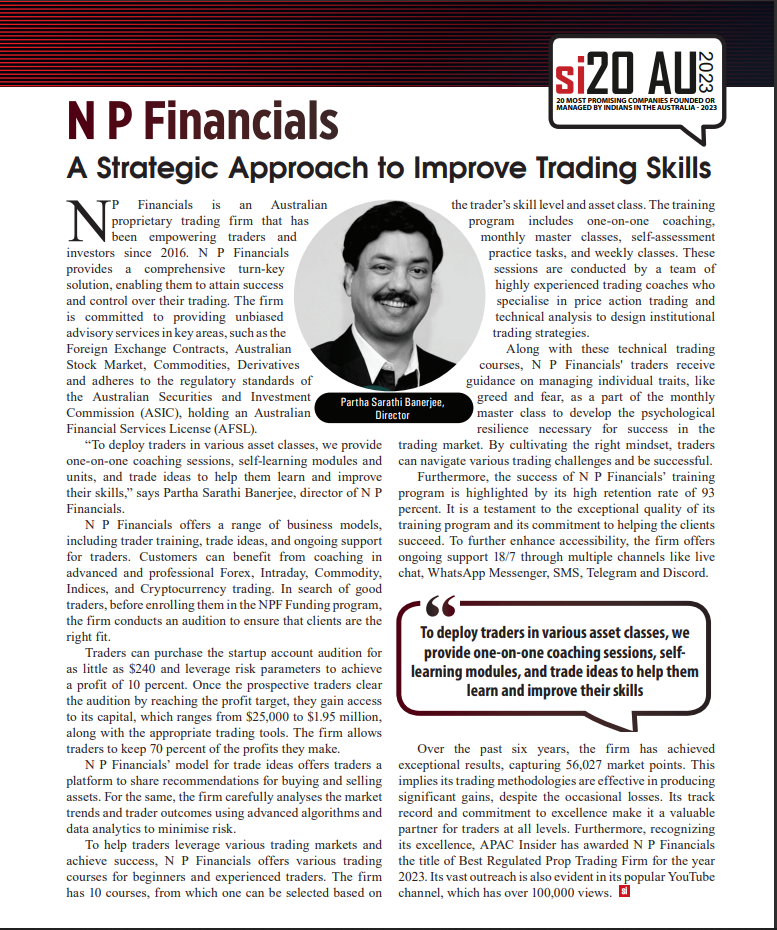
N P Financials has been awarded as one of the most promising companies founded or managed by Indians in Australia 2023.
N P Financials (NPF) is an Australian proprietary trading firm that has been empowering traders and investors since 2016. N P Financials provides a comprehensive turn-key solution, enabling them to attain success and control over their trading. The firm is committed to providing unbiased advisory services in key areas, such as the Foreign Exchange Contracts, Australian Stock Market, Commodities, Derivatives and adheres to the regulatory standards of the Australian Securities and Investment Commission (ASIC), holding an Australian Financial Services License (AFSL).
“To deploy traders in various asset classes, N P Financials provide one-on-one coaching sessions, self-learning modules and units, and trade ideas to help them learn and improve their skills,” says Partha Sarathi Banerjee, director of N P Financials.
N P Financials offers a range of business models, including trader training, trade ideas, and ongoing support for traders. Clients can benefit from coaching in advanced and professional Forex, Intraday, Commodity, Indices, and Cryptocurrency trading. In search of good traders, before enrolling them in the NPF Funding program, the firm conducts an audition to ensure that clients are the right fit.
Traders can purchase the startup account audition for as little as $240 and leverage risk parameters to achieve a profit of 10 percent. Once the prospective traders clear the audition by reaching the profit target, they gain access to its capital, which ranges from US $25,000 to US $1.95 million, along with the appropriate trading tools. The firm allows traders to keep 70 percent of the profits they make.
N P Financials’ model for trade ideas offers traders a platform to share recommendations for buying and selling assets. For the same, the firm carefully analyses the market trends and trader outcomes using advanced algorithms and data analytics to minimise risk.
To help traders leverage various trading markets and achieve success, N P Financials offers various trading courses for beginners and experienced traders. The firm has 10 courses, from which one can be selected based on the trader’s skill level and asset class. The training program includes one-on-one coaching, monthly master classes, self-assessment practice tasks, and weekly classes. These sessions are conducted by a team of highly experienced trading coaches who specialise in price action trading and technical analysis to design institutional trading strategies.
Along with these technical trading courses, N P Financials’ traders receive guidance on managing individual traits, like greed and fear, as a part of the monthly master class to develop the psychological resilience necessary for success in the trading market. By cultivating the right mindset, traders can navigate various trading challenges and be successful. Furthermore, the success of N P Financials’ training program is highlighted by its high retention rate of 93 percent. It is a testament to the exceptional quality of its training program and its commitment to helping the clients succeed. To further enhance accessibility, the firm offers ongoing support 18/7 through multiple channels like live chat, WhatsApp Messenger, SMS, Telegram and Discord.
Over the past six and half years, the firm has achieved exceptional results, capturing 60,777 market points. This implies its trading methodologies are effective in producing significant gains, despite the occasional losses. Its track record and commitment to excellence make it a valuable partner for traders at all levels. Furthermore, recognizing its excellence, APAC Insider has awarded N P Financials the title of Best Regulated Prop Trading Firm for the year 2023. Its vast outreach is also evident in its popular YouTube channel, which has over 100,000 views.
N P Financials can be contacted at:
[email protected]
+61 3 9790 6476
N P Financials Pty Ltd
Level 3, 2 Brandon Park Drive
Wheelers Hill, Victoria 3150
=====================================================
Unveiling the Remarkable Journey of N P Financials: Pioneering Success in the Forex World
Title: From Humble Beginnings to Forex Mastery: The Story of N P Financials
Introduction:
In the vast and dynamic world of Forex trading, one name stands out for its unwavering commitment to excellence and innovation: N P Financials. Let’s embark on a captivating journey through the history of N P Financials, a trailblazer in the Forex industry.
Origins:
N P Financials was founded in 2013 by visionary trader and entrepreneur, Partha Banerjee. Fuelled by a deep passion for empowering traders, the company started as a small trading community, dedicated to sharing insights, strategies, and fostering a supportive environment.
Expansion and Evolution:
As N P Financials gained recognition for its expertise and dedication to trader success, it expanded its offerings. The company ventured into trader training, providing comprehensive courses that unlocked the secrets of the forex market. Soon, N P Financials became synonymous with quality education, mentorship, funding, trade-ideas and trader’s psychology. Recently because of its outstanding contribution, APAC Insider has recognized N P Financials as the “Best Regulated Prop Trading Firm 2023- Australia”.
Innovation and Technology:
With the ever-evolving landscape of Forex trading, N P Financials stayed at the forefront of technological advancements. Embracing cutting-edge tools and platforms, the company offered traders access to state-of-the-art resources, real-time market analysis, high probable trade-ideas and advanced trading algorithms.
Trader Funding and Support:
Understanding the challenges faced by aspiring traders, N P Financials introduced trader funding programs. Through its proprietary evaluation process, traders could access capital (from US$ 25,000 to US$ 1.925 million) and trade with confidence. The company’s unwavering 18/7 support ensured that traders received guidance and assistance whenever needed.
Global Impact and Recognition:
N P Financials’ impact extended beyond borders, attracting traders from around the globe. Its commitment to transparency, credibility, and customer satisfaction earned it a loyal following. With over 10,000 students taught and 100,000+ YouTube views, N P Financials solidified its position as an industry leader.
Future Vision:
As N P Financials continues to innovate and adapt to changing market dynamics, its vision remains unchanged: to empower traders with the knowledge, tools, and support they need to succeed. With a relentless focus on excellence and a deep understanding of traders’ needs, N P Financials is poised to shape the future of Forex trading.
Conclusion:
The history of N P Financials is a testament to perseverance, innovation, and a genuine commitment to trader success. From its humble beginnings to its current position as a respected authority in the Forex industry, N P Financials continues to transform lives and pave the way for a new generation of successful traders.
Join us today and experience the unparalleled support that sets N P Financials apart. Whether you have a quick question or need in-depth guidance, we are committed to being there for you every step of the way. From our comprehensive Email assistance to real-time Live Chat, Landline phone, Mobile phone, WhatsApp, Messenger, SMS, Telegram, and Discord channels, we offer a diverse range of communication options to suit your preferences. Don’t miss out on this opportunity to empower your financial journey with the expertise of N P Financials.
Contact us now at +61 3 9790 6476 or email us at [email protected] to get started.
N P Financials Pty Ltd
Level 3, 2 Brandon Park Drive
Wheelers Hill, Victoria 3150
==================================================
Our blog post video:
In this blog post video, we have demonstrated the various ways N P Financials as one of the leading prop firms helping thousands of aspiring as well as professional traders to excel in their trading journey.
In a world of Forex trading prop firms where most people are chasing money and recognition, we focus on quality instead of quantity. Our one-on-one Forex Trading mentoring sessions come from the best of professional traders who have proven success in this industry- all sourced within Australia. There’s no better prop firms team for you to learn with than N P Financials.
We have been in this Trading business too long to know that there is no holy grail, all we do at N P Financials, as one of the leading prop firms, is look for trade opportunities that present higher probability than average. Successful Forex traders at N P Financials utilise practical, proven Forex trading strategies.
To us, entering the markets with a well-developed plan is the key to earning profits and building sustainable income in this exciting business of investing on international currencies. Our successful prop firms Forex traders are trained to know that success comes from following sound investment principles rather than guessing what will work best and we, as one of the leading prop firms, do so by employing an effective strategy tailored specifically for their needs.

In this very popular video, we have discussed in full length many things but the following extremely pertinent aspects of successful prop firms’ way of trading are really in-depth with lots of questions of the participants :
- N P Financials’ Discord Live Trading rooms‘ tour.
- Power of Channels– how to trade them under prop firms.
- How to take advantage of the leading Divergence indicator in prop firms?
- Which Audition/ Evaluation is suitable for your Trading Style and Why?
- Actual Lot size to be traded for different account sizes in prop firms.
- Concept of Liquidity Bars and how to Trade them in prop firms.
- Where to put stop-loss for Trading Liquidity Bar in prop firms.
- What happens behind the scene during Market open.
- How to identify and Trade “No Demand” days in prop firms?
- How to identify “Buying Complex“?
- How to avoid falling in a trap of a poor Trading position?
- How to develop an excellent Trade Journal in prop firms?
- How to read Currency Correlation in prop firms?
N P Financials offers a unique opportunity to learn how to trade under professional prop firms. This illustrative video provides an in-depth look at the power of channels and how they can be used to your advantage.
N P Financials’ leading divergence indicator is a powerful tool that can be used by prop firms to take advantage of certain market conditions. By understanding how this indicator works, prop firms can use it to their advantage and make informed decisions about when to enter and exit the market. N P Financials’ leading divergence indicator is based on the concept of leading indicators, which are indicators that can be used to predict future price movements much in advance.
Our team will help you find the right audition/evaluation process that is tailored to your trading style. Finally, we break down the concept of liquidity bars and show you how they can be traded for maximum profits under professional prop firms.
If you are interested in learning more about our Discord Live Trading rooms, please click here.
We are always there to support you, when you need it the most, either through Email, Live Chat, Landline phone, Mobile phone, WhatsApp, Messenger, SMS, Telegram and Discord.
N P Financials Pty Ltd
Level 3, 2 Brandon Park Drive
Wheelers Hill, Victoria 3150
Phone: +61 3 9790 6476
email: [email protected]
Let’s chat https://discord.gg/5HkVUCk6KB
====================================================================================================================================
Our Post dated 07.09.2022:
Celebrating 50,000 points from prop firms Trade Signals consistently for the last 68 months.
We are excited to announce that our trade signals have generated 50,000+ points consistently for the last 68 months in Forex, Shares, Commodities, Indices and Cryptocurrencies. A total of 585 trade signals were put in this last 68 months to generate these 50,000+ points. These 50,000+ points were captured at an average of 743 points per month with an average of 86 points per trade.
As Smart Traders at N P Financials, we pride ourselves in being able to generate consistent and reliable trade signals that have generated 50,000+ points over the last 68 months. In this blog post, we will show you how we have been able to achieve this consistency and what you can do to replicate our success.
In these 68 months, our trade signals have been accurate 83.82% of the time. Out of the 585 trade signals in the last 68 months, 513 of them were profitable while 72 were unprofitable. The biggest monthly return was 9,837 points in September 2018 and the biggest drawdown was -364 points in June 2022.
How our trade signals are created:
The first step to generating consistent trade signals is understanding the market. Our team of experienced traders spend countless hours analyzing the market so that we can identify any potential opportunities. Once we have identified an opportunity, we will then generate a trade signal for our members.
We have been in this Trading business too long to know that there is no holy grail, all we do at N P Financials is look for trade opportunities that present higher probability than average in all the 5 asset classes (Forex, Shares, Commodities, Indices and Cryptocurrencies). Our Trader Development Programs which you are (or will be) going through are extremely powerful and you will continue to benefit from our proprietary Trading Strategies, sample Trade Ideas which have generated 50,551 points in the last 68 months at an average of 743 points per month and 86 average points per Trade.
Our team of expert traders create these trade signals on a regular basis by analyzing the market conditions and price movements of various assets through our proprietary risk managed trading system. We take into consideration different factors such as support and resistance levels, ROF, trendlines, prop patterns, demand & supply levels, BONBT and much more. With years of experience in trading the financial markets, our team is able to generate trade signals that have helped our clients profit from the market movements.
Our trade signals are not based on guesswork or hunches. Instead, they are based on data-driven and technical analysis so that our traders can feel confident when they make a trade. In fact, our trade signals have an average success rate of 83.82%.
The next step is following our trade signals. We recommend that our members follow our email alerts so that they never miss a trade signal.
Once you have followed our trade signals and made a profit, it is important to take some time to learn from your successes and failures. This will help you become a better trader and increase your chances of success in the future.
The Benefits of using our trade signals:
By using our trade signals, you will be able to make informed decisions when trading various assets. You can either choose to trade manually or set up your own automated trading system to trade according to our signals. Our clients have found that by using our trade signals, they are able to save time and energy as they no longer need to do their own analysis of the markets.
In addition, by using our trade signals, you can be assured that you are getting reliable and accurate information that can help you generate points in the financial markets. Our expert trading team carefully analyzes the different markets before issuing a signal so that you can be confident that you are making a wise decision when entering or exit a trade.
Conclusion:
If you are looking for a reliable way to generate points in the financial tradeable markets, look no further than our trade signals! With an accuracy rate of 83.82%, you can be assured that you will be generating points if you follow our trade signals. Trading has never been easier with our team doing all the analysis for you! All you need to do is follow our trade signals!
By following the steps outlined in this blog post, you can increase your chances of success as a trader and generate consistent points over time. If you would like to learn more about how to trade or if you need help setting up email alerts, please feel free to contact us at +61 3 9790 6476 or [email protected]. Thank you for reading!
We have been achieving these types of successes for the last 7 years through our Proprietary Trading Strategies as demonstrated in our blog posts. You can also derive such profitable benefits when you are trained by us.
We are always there to support you, when you need it the most, either through Email, Live Chat, Landline phone, Mobile phone, WhatsApp, Messenger, SMS, Telegram and Discord.
N P Financials Pty Ltd
Level 3, 2 Brandon Park Drive
Wheelers Hill, Victoria 3150
Phone: +61 3 9790 6476
email: [email protected]
Let’s chat https://discord.gg/5HkVUCk6KB
=================================================================================================================================
Our Blog post dated 20th of August’ 2022:
10 Trades in our Free Discord Channels resulted in 13,097 points in the last 1 month.
Markets are moving fast, so are we. In the last 1 month, 10 Trades have resulted in a massive 13,097 points. Let us take this opportunity to discuss these recent 10 Trades. These 10 Trades are from different asset classes viz. Shares, Indices, Commodities and Cryptocurrencies.
Let’s break these 10 trades asset class-wise:
Square (Now Block Inc) Inc trades
Amazon Inc trades
Apple Inc trades
CSL Ltd trades
Spot Gold trades
Natural Gas trades
DAX40 (or GER30) trades
Hangseng 50 (HK50) trades
SPX500 trades
ETHUSD (Ethereum) trades
Out of these 10 Trades, first one is Square (now Block Inc) Inc.
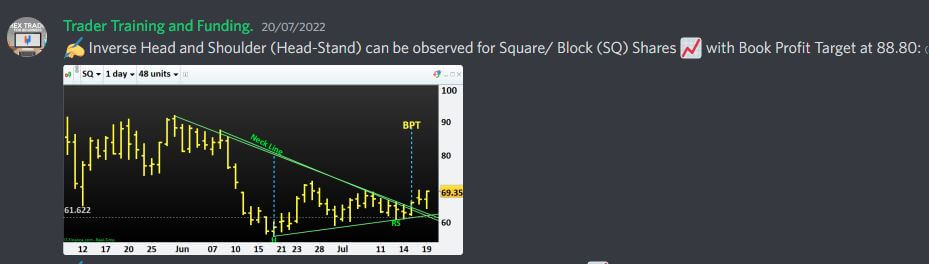
In our analysis for Square Inc share trades on 20.07.2022 on our Discord (https://discord.gg/5HkVUCk6KB) Share Trading Room, we wrote, “ Inverse Head and Shoulder (Head-Stand) can be observed for Square/ Block (SQ) Share trades
  with Book Profit Target at 88.80” when Block shares were trading at 69.35.
Exactly as per above analysis, Square (now Block Inc) Inc reached our set Profit Target with a gain of 1,945 points for 100 shares which is equivalent to $1,945 when invested $1 per point and $19,450 when invested $10 per point (standard lot).
Out of these 10 Trades, 2nd one is Amazon Inc.
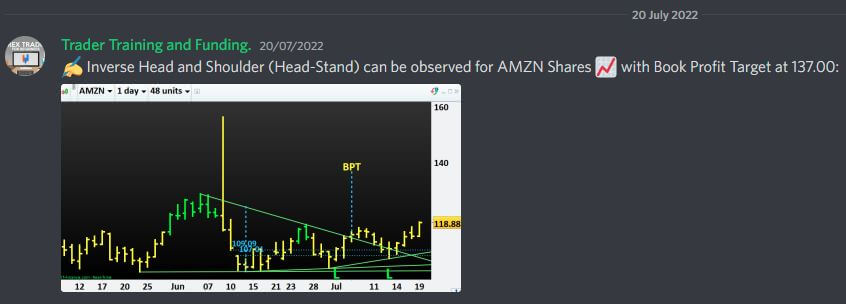
In our analysis for Amazon Inc share trades on 20.07.2022 on our Discord (https://discord.gg/5HkVUCk6KB) Share Trading Room, we wrote, “ Inverse Head and Shoulder (Head-Stand) can be observed for Amazon (AMZN) Share trades with Book Profit Target at 137.00” when Amazon shares were trading at 118.88.
Exactly as per above analysis, Amazon Inc reached our set Profit Target with a gain of 1,812 points for 100 shares which is equivalent to $1,812 when invested $1 per point and $18,120 when invested $10 per point (standard lot).
Out of these 10 Trades, one other share is CSL Ltd
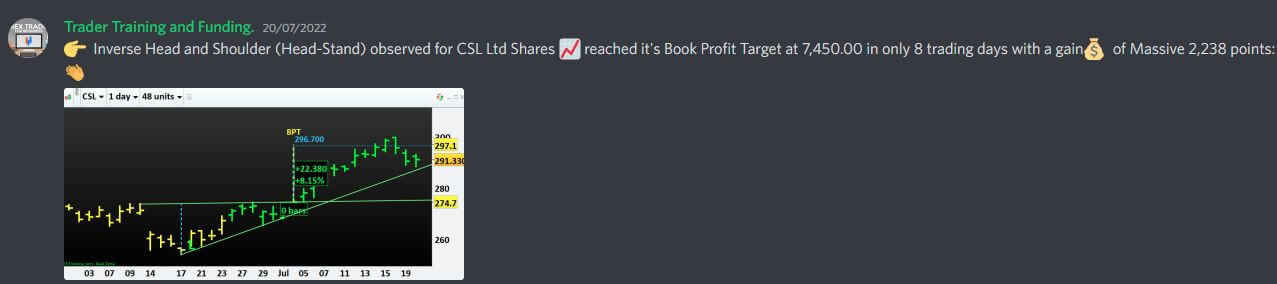
Our analysis for CSL Ltd share trades on 20.07.2022 on our Discord (https://discord.gg/5HkVUCk6KB) Share Trading Room: Inverse Head and Shoulder (Head-Stand) observed for CSL Ltd Shares reached it’s Book Profit Target at 296.70 in only 8 trading days with a massive gain of 2,238 points which is equivalent to $2,238 when invested $1 per point and $22,380 when invested $10 per point (standard lot).
Out of these 10 Trades, one Cryptocurrency is ETHUSD
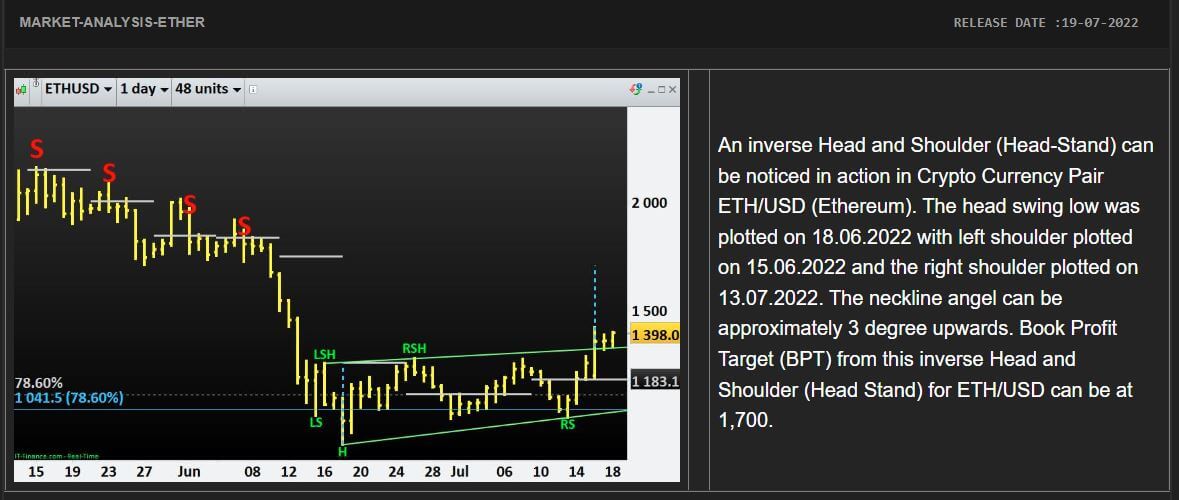
Our analysis for ETHUSD Cryptocurrency trades on 19.07.2022 on our Discord (https://discord.gg/5HkVUCk6KB) Cryptocurrency Trading Room: Inverse Head and Shoulder (Head-Stand) observed for ETHUSD reached it’s Book Profit Target at 1,770 with a gain of massive 302 points which is equivalent to $302 when invested $1 per point and $3,020 when invested $10 per point (standard lot).
Out of these 10 Trades, one Index is SPX500
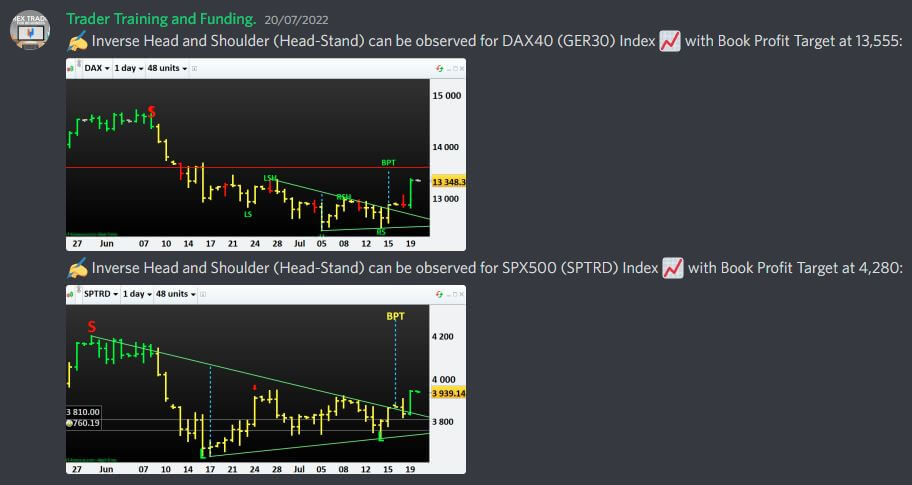
Our analysis for SPX500 Index trades on 20.07.2022 on our Discord (https://discord.gg/5HkVUCk6KB) Index Trading Room, we wrote, “ Inverse Head and Shoulder (Head-Stand) can be observed for SPX500 Index with Book Profit Target at 4,280” when SPX500 was trading at 3,939.
Exactly as per above analysis, SPX500 reached our set Profit Target with a gain of 341 points which is equivalent to $341 when invested $1 per point and $3,410 when invested $10 per point (standard lot).
Out of these 10 Trades, one other Index is DAX40 (GER30)
Our analysis for DAX40 (GER30) Index trades on 20.07.2022 on our Discord (https://discord.gg/5HkVUCk6KB) Index Trading Room, we wrote, “ Inverse Head and Shoulder (Head-Stand) can be observed for DAX40 (GER30) Index with Book Profit Target at 13,555” when DAX40 was trading at 13,348.
Exactly as per above analysis, DAX40 reached our set Profit Target with a gain of 207 points which is equivalent to $207 when invested $1 per point and $2,070 when invested $10 per point (standard lot).
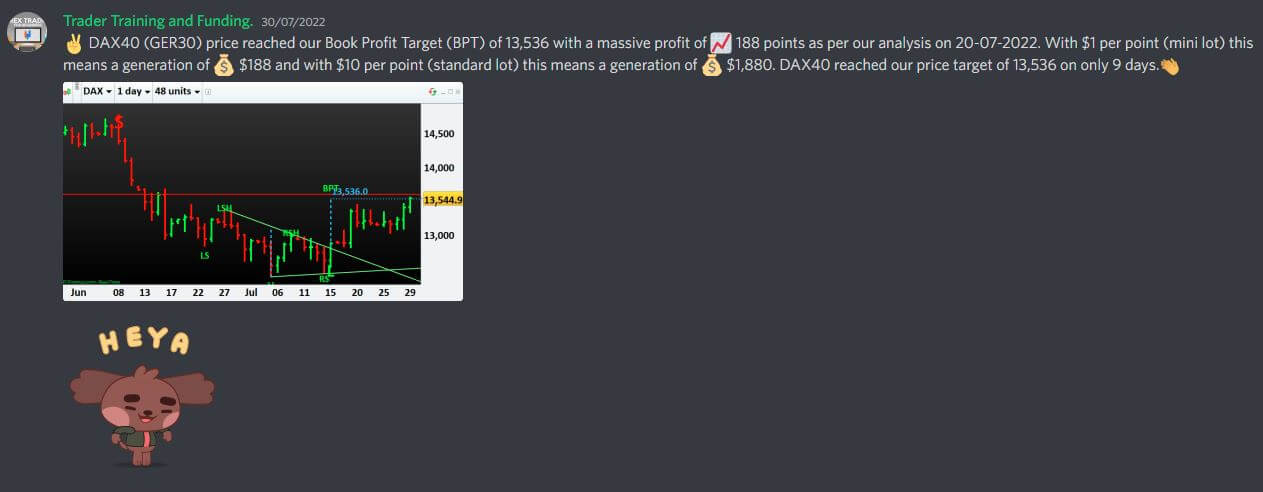
Out of these 10 Trades, one Commodity is Natural Gas (NG)
Our analysis for Natural Gas (NG) Commodity trades on 20.07.2022 on our Discord (https://discord.gg/5HkVUCk6KB) Commodity Trading Room: Inverse Head and Shoulder (Head-Stand) observed for NG (Natural Gas) Commodity reached it’s Book Profit Target at 7,450.00 in only 7 trading days with a massive gain of 1,190 points which is equivalent to $1,190 when invested $1 per point and $11,190 when invested $10 per point (standard lot).
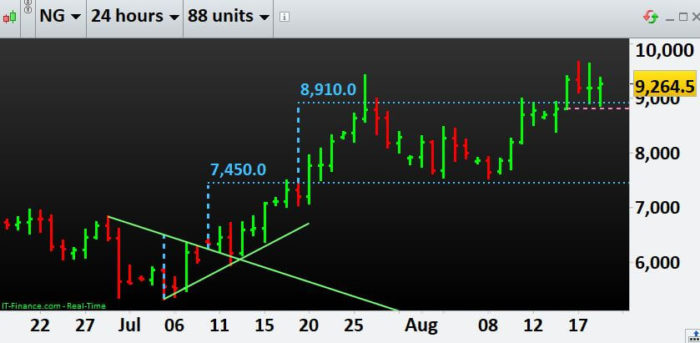
The rest 4 instrument trades (AAPL shares, Spot Gold, Hangseng 50 (HK50)) did reach all their set profit targets resulting in a humongous total gain of 13,097 points in the last 1 month.
We have been achieving these types of successes for the last 7 years through our Proprietary Trading Strategies as demonstrated in our blog posts. You can also derive such profitable benefits when you are trained by us.
We are always there to support you, when you need it the most, either through Email, Live Chat, Landline phone, Mobile phone, WhatsApp, Messenger, SMS, Telegram and Discord.
N P Financials Pty Ltd
Level 3, 2 Brandon Park Drive
Wheelers Hill, Victoria 3150
Phone: +61 3 9790 6476
email: [email protected]
Let’s chat https://discord.gg/5HkVUCk6KB
=================================================================================================================================
Our Blog Post dated 31.07.2022:
Amazon Share Price reached our Profit Target.
On 18.07.2022, we analysed the share price of Amazon when it was trading at 113.77.
In our analysis for the share price of Amazon in our paid Client Arena, we wrote, “An interesting inverse Head and Shoulder (Head-Stand) can be noticed in action in Amazon Inc Share’s Daily Price Pattern. The head swing low was plotted on 14.06.2022 with left shoulder plotted on 24.05.2022 and the right shoulder plotted on 30.06.2022.
The neckline angel can be approximately 29 degree downwards. Book Profit Target (BPT) from this inverse Head and Shoulder (Head Stand) for AMZN/USD can be at 136.36 if the price is crossing to the upside of 118.18 level”.
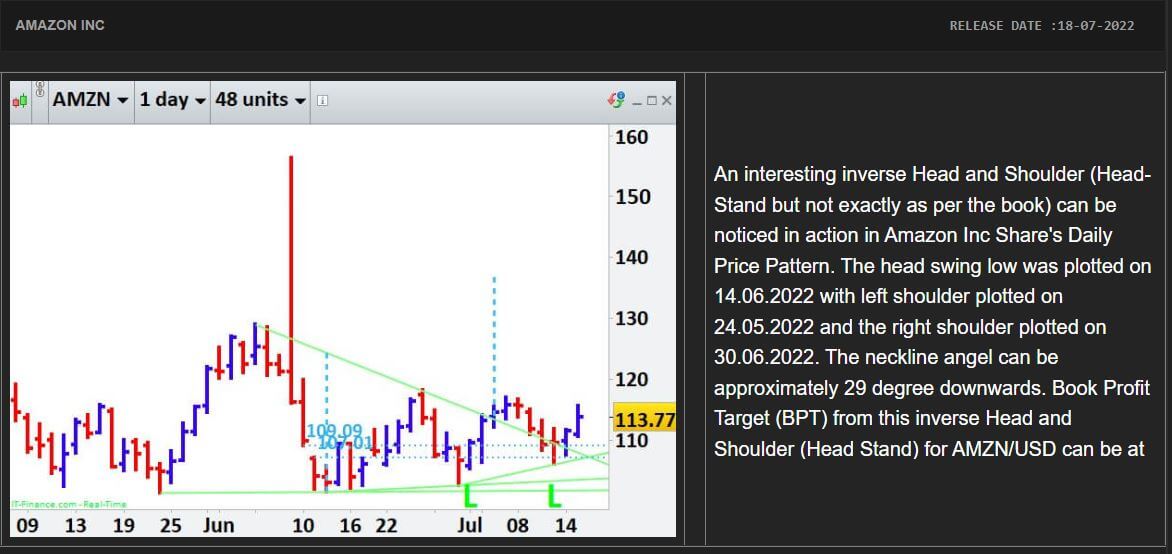
From 18-07-2022 to 29-07-2022, within only 10 days, Amazon share price reached our Book Profit Target (BPT) of 136.36 with a humongous profit of 2,259 points.
With $1 per point (mini lot) this means a generation of $2,259 and with $10 per point (standard lot) this means a generation of $22,590.
We have been achieving these types of successes for the last 7 years through our blog posts. You can also do the same.
We are always there to support you, when you need it the most, either through Email, Live Chat, Landline phone, Mobile phone, WhatsApp, Messenger, SMS, Telegram and Discord.
N P Financials Pty Ltd
Level 3, 2 Brandon Park Drive
Wheelers Hill, Victoria 3150
Phone: +61 3 9790 6476
email: [email protected]
Let’s chat https://discord.gg/5HkVUCk6KB
=================================================================================================================================