
3 Shares & 3 Indices have hit 10 set Profit Targets according to our Pattern Analysis in the last 8 days alone
3 Shares & 3 Indices have hit 10 set Profit Targets according to our Pattern Analysis in the last 8 days alone. In the dynamic

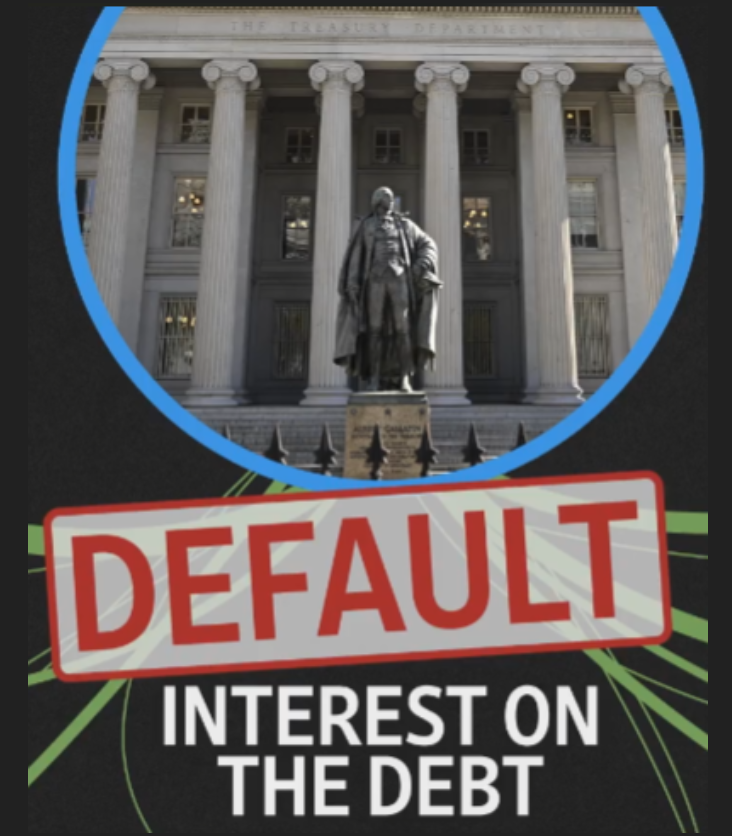
In this blog post we will explore the following burning topic:
The national debt of the United States has increased significantly, leading to the need for the U.S. Treasury Department to borrow more money to fund government spending.
The limit on this borrowing is known as the debt ceiling, and when the Treasury Department reaches this limit, Congress must vote on or before 01.06.2023 to either suspend or raise the limit on borrowing.
If Congress fails to reach an agreement on the debt ceiling, economists warn of severe consequences, including the possibility of default.
The United States Congress has raised the maximum amount of money that the government can borrow (known as the “ceiling”) 78 times since 1960. The most recent increase happened in 2021.
“Congress” refers to the legislative branch of the US government, which is responsible for making laws and overseeing government operations.
“Ceiling” refers to the maximum amount of money that the US government is allowed to borrow, as set by Congress.
If Congress fails to raise it, dire consequences could occur, including default, a downgrade by credit rating agencies, increased borrowing costs, and a drop in consumer confidence.
The breach of the debt ceiling could halt about one-tenth of U.S. economic activity and cause the loss of three million jobs.
President Biden and Republican leader Kevin McCarthy, on 27th of May’ 2023, have come to an agreement to temporarily stop the government from hitting its debt limit until the year 2025.
Introduction:
In recent years, the topic of US debt has been making headlines around the world. With the increasing national debt and concerns about a possible default, it’s crucial to understand the implications and reasons behind the fuss. In this blog post, we will delve into the concept of US debt, explore the potential consequences of a debt default, and analyse the factors contributing to this ongoing concern. So, let’s unravel the complexities surrounding US debt and gain a comprehensive understanding of its significance.
Understanding US Debt:
The US debt refers to the total amount of money owed by the federal government. It includes both domestic and foreign debt, encompassing various forms of borrowings such as Treasury bonds, bills, and notes. Over time, the debt has grown substantially, reaching unprecedented levels. As of May 23,2023, the US national debt has exceeded $31,462,154,854,902, which has led to apprehensions regarding its sustainability.
Implications of US Debt Default:
A debt default occurs when a country fails to make payments on its outstanding debt obligations. While the United States has never defaulted on its debt, the possibility of it happening in the future raises significant concerns. Here are some potential implications of a US debt default:
(Image Source: https://www.wsj.com/video/series/news-explainers/)
a. Economic Consequences: A default could trigger a severe economic downturn, leading to higher interest rates, reduced access to credit, and increased borrowing costs for the government. This could have a detrimental impact on businesses, investments, and job creation.
b. Global Financial Instability: Given the global significance of the US economy, a debt default could have far-reaching consequences worldwide. It may undermine investor confidence, destabilize financial markets, and lead to a chain reaction of economic turmoil in other countries.
c. Currency Depreciation: A default could weaken the value of the US dollar, eroding its status as the world’s reserve currency. This would result in higher import costs, inflationary pressures, and decreased purchasing power for American consumers.
Factors Contributing to the Concern:
Several factors contribute to the growing concerns surrounding US debt and the possibility of default. Here are some key elements to consider:
a. Fiscal Policy and Deficit Spending: The US government’s fiscal policy plays a crucial role in managing the national debt. When spending exceeds revenue, the government needs to borrow money to cover the deficit. Unsustainable deficit spending and a lack of effective debt reduction strategies contribute to the growing debt burden.
b. Political Gridlock: Political divisions and partisan struggles often hamper the government’s ability to address the debt issue. Disagreements on spending priorities, taxation policies, and entitlement programs hinder the implementation of comprehensive solutions, further exacerbating the problem.
c. Demographic Challenges: The aging population and rising healthcare costs pose long-term challenges for the US economy. As more Americans become eligible for social security and Medicare, government expenditures increase, putting additional strain on the national debt.
d. External Factors: Global economic conditions, such as trade imbalances, currency fluctuations, and geopolitical uncertainties, can impact the US debt situation. For example, the ongoing trade disputes with major trading partners can affect economic growth, government revenues, and the ability to service the debt.
Potential Solutions and Mitigation Measures:
Addressing the US debt challenge requires a multifaceted approach. Here are some potential solutions and mitigation measures that could help manage the situation:
a. Fiscal Responsibility: Implementing responsible fiscal policies, including reducing unnecessary spending, increasing revenue through tax reforms, and promoting economic growth, can help reduce the budget deficit and slow the accumulation of debt.
b. Entitlement Reforms: Evaluating and making necessary adjustments to entitlement programs, such as Social Security and Medicare, can contribute to long-term debt reduction and ensure their sustainability for future generations.
c. Budgetary Constraints: Implementing stricter budgetary controls and adopting a more disciplined approach to government spending can help curb the growth of the national debt. This includes evaluating and prioritizing expenditures, eliminating wasteful programs, and enhancing efficiency in government operations.
d. Economic Growth and Job Creation: Fostering a favorable business environment that promotes economic growth and job creation can generate increased tax revenues and reduce the need for excessive borrowing. This can be achieved through policies that encourage entrepreneurship, innovation, and investment.
e. Bipartisan Cooperation: Overcoming political gridlock and fostering bipartisan cooperation is crucial for implementing effective debt reduction strategies. By finding common ground and working together, lawmakers can develop sustainable solutions that address the nation’s long-term fiscal challenges.
f. Public Awareness and Education: Increasing public awareness about the consequences of excessive debt and the importance of responsible fiscal management can create a more informed citizenry. This can help foster a sense of urgency and encourage individuals to engage with policymakers on debt-related issues.
Conclusion:
The topic of US debt and the possibility of a default is indeed a cause for concern. A debt default could have far-reaching implications, both domestically and globally, impacting the economy, financial stability, and the standard of living. However, by understanding the factors contributing to the debt burden and implementing effective solutions, it is possible to mitigate the risks associated with a default.
Responsible fiscal policies, prudent budgetary controls, entitlement reforms, and bipartisan cooperation are essential components of a comprehensive approach to address the US debt challenge. Furthermore, public awareness and engagement play a vital role in ensuring that policymakers remain accountable and committed to sustainable debt reduction strategies.
While the future trajectory of US debt remains uncertain, it is crucial for policymakers, economists, and citizens to stay informed and actively participate in shaping the fiscal policies that will determine the nation’s financial future. By taking proactive measures today, we can strive to ensure a more stable and prosperous economic landscape for future generations.
Remember, the US debt issue is complex, and its resolution requires a collective effort and a long-term perspective. By understanding the fuss surrounding US debt and actively participating in the dialogue, we can contribute to a more sustainable and economically secure future for our nation.
If you want to know more on this type of Fundamentals and aim to achieve consistent results in your Forex trading and pass the NPF Capital Audition by utilizing our time-tested and proven strategies, do not hesitate to contact us immediately at [email protected] or call us at +61 3 9790 6476. Don’t waste any more time, take action now!
We are always there to support you, when you need it the most, either through Email, Live Chat, Landline phone, Mobile phone, WhatsApp, Messenger, SMS, Telegram and Discord.
N P Financials Pty Ltd
Level 3, 2 Brandon Park Drive
Wheelers Hill, Victoria 3150
Phone: +61 3 9790 6476
========================================================
N P Financials is Awarded as the Best Regulated Prop Trading Firm 2023- Australia
In this blog post video, we have demonstrated the various ways N P Financials as one of the leading prop firms helping thousands of aspiring as well as professional traders to excel in their trading journey.
In a world of Forex trading prop firms where most people are chasing money and recognition, we focus on quality instead of quantity. Our one-on-one Forex Trading mentoring sessions come from the best of professional traders who have proven success in this industry- all sourced within Australia. There’s no better prop firms team for you to learn with than N P Financials.
We have been in this Trading business too long to know that there is no holy grail, all we do at N P Financials, as one of the leading prop firms, is look for trade opportunities that present higher probability than average. Successful Forex traders at N P Financials utilise practical, proven Forex trading strategies.
To us, entering the markets with a well-developed plan is the key to earning profits and building sustainable income in this exciting business of investing on international currencies. Our successful prop firms Forex traders are trained to know that success comes from following sound investment principles rather than guessing what will work best and we, as one of the leading prop firms, do so by employing an effective strategy tailored specifically for their needs.

In this very popular video, we have discussed in full length many things but the following extremely pertinent aspects of successful prop firms’ way of trading are really in-depth with lots of questions of the participants :
N P Financials offers a unique opportunity to learn how to trade under professional prop firms. This illustrative video provides an in-depth look at the power of channels and how they can be used to your advantage.
N P Financials’ leading divergence indicator is a powerful tool that can be used by prop firms to take advantage of certain market conditions. By understanding how this indicator works, prop firms can use it to their advantage and make informed decisions about when to enter and exit the market. N P Financials’ leading divergence indicator is based on the concept of leading indicators, which are indicators that can be used to predict future price movements much in advance.
Our team will help you find the right audition/evaluation process that is tailored to your trading style. Finally, we break down the concept of liquidity bars and show you how they can be traded for maximum profits under professional prop firms.
If you are interested in learning more about our Discord Live Trading rooms, please click here.
We are always there to support you, when you need it the most, either through Email, Live Chat, Landline phone, Mobile phone, WhatsApp, Messenger, SMS, Telegram and Discord.
Level 3, 2 Brandon Park Drive
Wheelers Hill, Victoria 3150
Phone: +61 3 9790 6476
email: [email protected]
Let’s chat https://discord.gg/5HkVUCk6KB
====================================================================================================================================
Our Post dated 07.09.2022:
We are excited to announce that our trade signals have generated 50,000+ points consistently for the last 68 months in Forex, Shares, Commodities, Indices and Cryptocurrencies. A total of 585 trade signals were put in this last 68 months to generate these 50,000+ points. These 50,000+ points were captured at an average of 743 points per month with an average of 86 points per trade.
As Smart Traders at N P Financials, we pride ourselves in being able to generate consistent and reliable trade signals that have generated 50,000+ points over the last 68 months. In this blog post, we will show you how we have been able to achieve this consistency and what you can do to replicate our success.
In these 68 months, our trade signals have been accurate 83.82% of the time. Out of the 585 trade signals in the last 68 months, 513 of them were profitable while 72 were unprofitable. The biggest monthly return was 9,837 points in September 2018 and the biggest drawdown was -364 points in June 2022.
How our trade signals are created:
The first step to generating consistent trade signals is understanding the market. Our team of experienced traders spend countless hours analyzing the market so that we can identify any potential opportunities. Once we have identified an opportunity, we will then generate a trade signal for our members.
We have been in this Trading business too long to know that there is no holy grail, all we do at N P Financials is look for trade opportunities that present higher probability than average in all the 5 asset classes (Forex, Shares, Commodities, Indices and Cryptocurrencies). Our Trader Development Programs which you are (or will be) going through are extremely powerful and you will continue to benefit from our proprietary Trading Strategies, sample Trade Ideas which have generated 50,551 points in the last 68 months at an average of 743 points per month and 86 average points per Trade.
Our team of expert traders create these trade signals on a regular basis by analyzing the market conditions and price movements of various assets through our proprietary risk managed trading system. We take into consideration different factors such as support and resistance levels, ROF, trendlines, prop patterns, demand & supply levels, BONBT and much more. With years of experience in trading the financial markets, our team is able to generate trade signals that have helped our clients profit from the market movements.
Our trade signals are not based on guesswork or hunches. Instead, they are based on data-driven and technical analysis so that our traders can feel confident when they make a trade. In fact, our trade signals have an average success rate of 83.82%.
The next step is following our trade signals. We recommend that our members follow our email alerts so that they never miss a trade signal.
Once you have followed our trade signals and made a profit, it is important to take some time to learn from your successes and failures. This will help you become a better trader and increase your chances of success in the future.
The Benefits of using our trade signals:
By using our trade signals, you will be able to make informed decisions when trading various assets. You can either choose to trade manually or set up your own automated trading system to trade according to our signals. Our clients have found that by using our trade signals, they are able to save time and energy as they no longer need to do their own analysis of the markets.
In addition, by using our trade signals, you can be assured that you are getting reliable and accurate information that can help you generate points in the financial markets. Our expert trading team carefully analyzes the different markets before issuing a signal so that you can be confident that you are making a wise decision when entering or exit a trade.
Conclusion:
If you are looking for a reliable way to generate points in the financial tradeable markets, look no further than our trade signals! With an accuracy rate of 83.82%, you can be assured that you will be generating points if you follow our trade signals. Trading has never been easier with our team doing all the analysis for you! All you need to do is follow our trade signals!
By following the steps outlined in this blog post, you can increase your chances of success as a trader and generate consistent points over time. If you would like to learn more about how to trade or if you need help setting up email alerts, please feel free to contact us at +61 3 9790 6476 or [email protected]. Thank you for reading!
We have been achieving these types of successes for the last 7 years through our Proprietary Trading Strategies as demonstrated in our blog posts. You can also derive such profitable benefits when you are trained by us.
We are always there to support you, when you need it the most, either through Email, Live Chat, Landline phone, Mobile phone, WhatsApp, Messenger, SMS, Telegram and Discord.
Level 3, 2 Brandon Park Drive
Wheelers Hill, Victoria 3150
Phone: +61 3 9790 6476
email: [email protected]
Let’s chat https://discord.gg/5HkVUCk6KB
=================================================================================================================================
Our Blog post dated 20th of August’ 2022:
Markets are moving fast, so are we. In the last 1 month, 10 Trades have resulted in a massive 13,097 points. Let us take this opportunity to discuss these recent 10 Trades. These 10 Trades are from different asset classes viz. Shares, Indices, Commodities and Cryptocurrencies.
Let’s break these 10 trades asset class-wise:
Square (Now Block Inc) Inc trades
Amazon Inc trades
Apple Inc trades
CSL Ltd trades
Spot Gold trades
Natural Gas trades
DAX40 (or GER30) trades
Hangseng 50 (HK50) trades
SPX500 trades
ETHUSD (Ethereum) trades
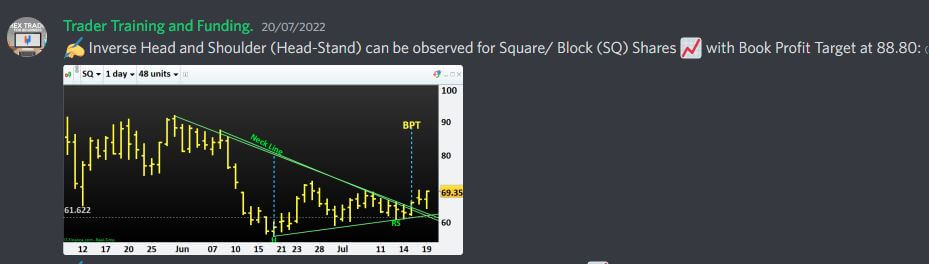
In our analysis for Square Inc share trades on 20.07.2022 on our Discord (https://discord.gg/5HkVUCk6KB) Share Trading Room, we wrote, “ Inverse Head and Shoulder (Head-Stand) can be observed for Square/ Block (SQ) Share trades
  with Book Profit Target at 88.80” when Block shares were trading at 69.35.
Exactly as per above analysis, Square (now Block Inc) Inc reached our set Profit Target with a gain of 1,945 points for 100 shares which is equivalent to $1,945 when invested $1 per point and $19,450 when invested $10 per point (standard lot).
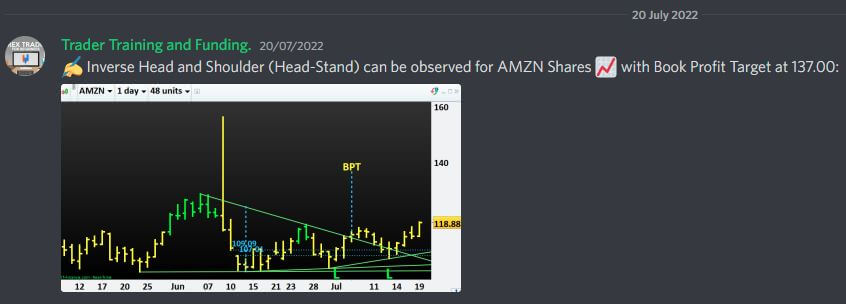
In our analysis for Amazon Inc share trades on 20.07.2022 on our Discord (https://discord.gg/5HkVUCk6KB) Share Trading Room, we wrote, “ Inverse Head and Shoulder (Head-Stand) can be observed for Amazon (AMZN) Share trades with Book Profit Target at 137.00” when Amazon shares were trading at 118.88.
Exactly as per above analysis, Amazon Inc reached our set Profit Target with a gain of 1,812 points for 100 shares which is equivalent to $1,812 when invested $1 per point and $18,120 when invested $10 per point (standard lot).
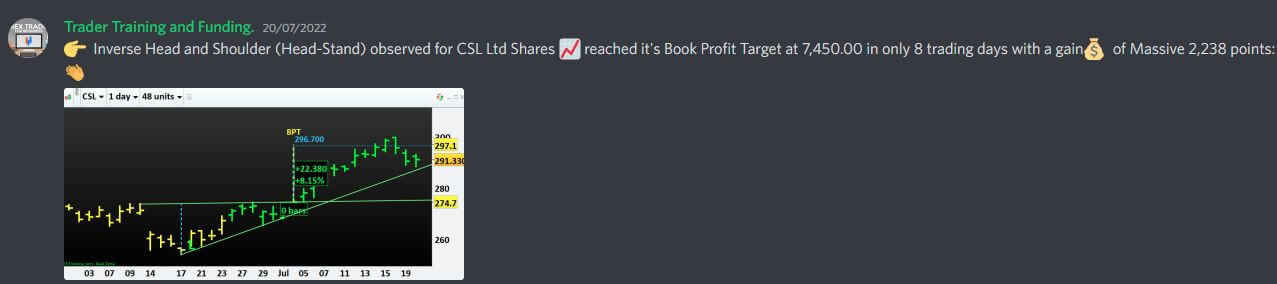
Our analysis for CSL Ltd share trades on 20.07.2022 on our Discord (https://discord.gg/5HkVUCk6KB) Share Trading Room: Inverse Head and Shoulder (Head-Stand) observed for CSL Ltd Shares reached it’s Book Profit Target at 296.70 in only 8 trading days with a massive gain of 2,238 points which is equivalent to $2,238 when invested $1 per point and $22,380 when invested $10 per point (standard lot).
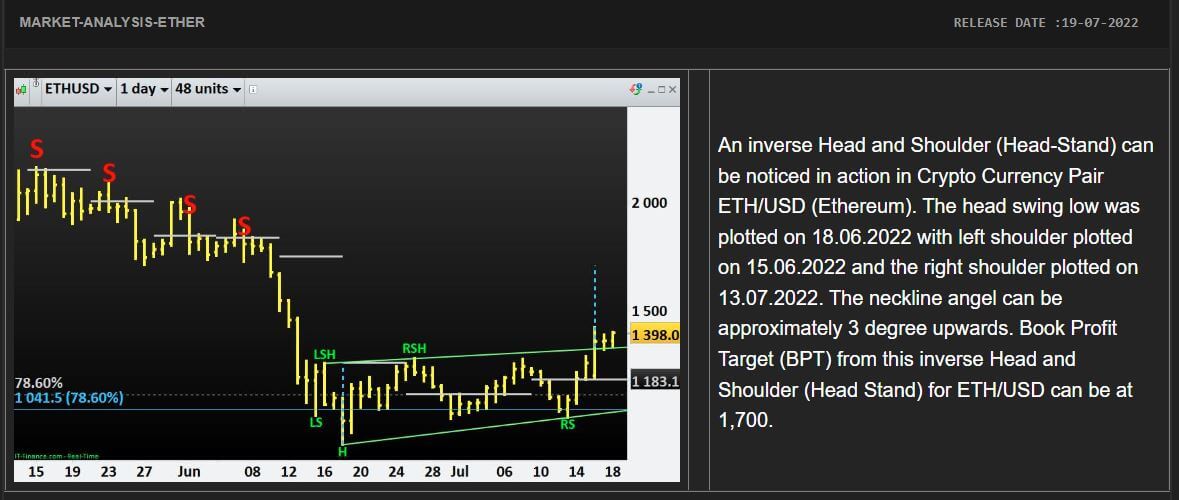
Our analysis for ETHUSD Cryptocurrency trades on 19.07.2022 on our Discord (https://discord.gg/5HkVUCk6KB) Cryptocurrency Trading Room: Inverse Head and Shoulder (Head-Stand) observed for ETHUSD reached it’s Book Profit Target at 1,770 with a gain of massive 302 points which is equivalent to $302 when invested $1 per point and $3,020 when invested $10 per point (standard lot).
Our analysis for SPX500 Index trades on 20.07.2022 on our Discord (https://discord.gg/5HkVUCk6KB) Index Trading Room, we wrote, “ Inverse Head and Shoulder (Head-Stand) can be observed for SPX500 Index with Book Profit Target at 4,280” when SPX500 was trading at 3,939.
Exactly as per above analysis, SPX500 reached our set Profit Target with a gain of 341 points which is equivalent to $341 when invested $1 per point and $3,410 when invested $10 per point (standard lot).
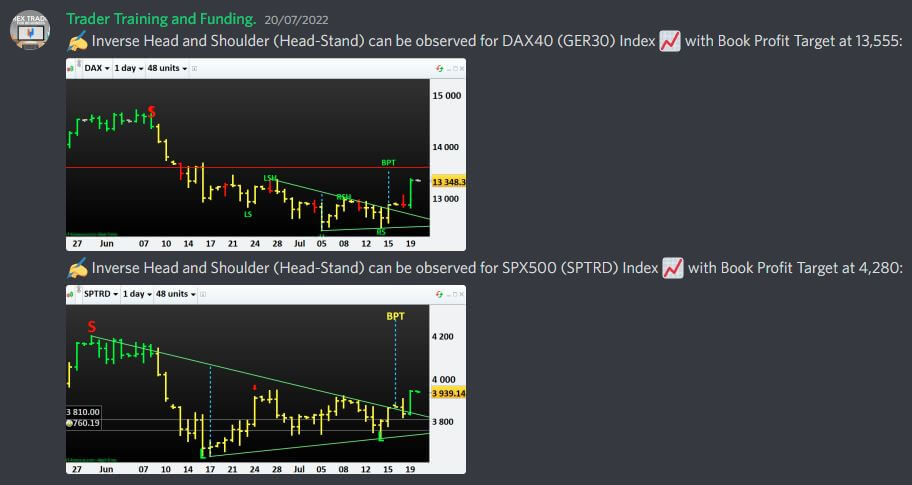
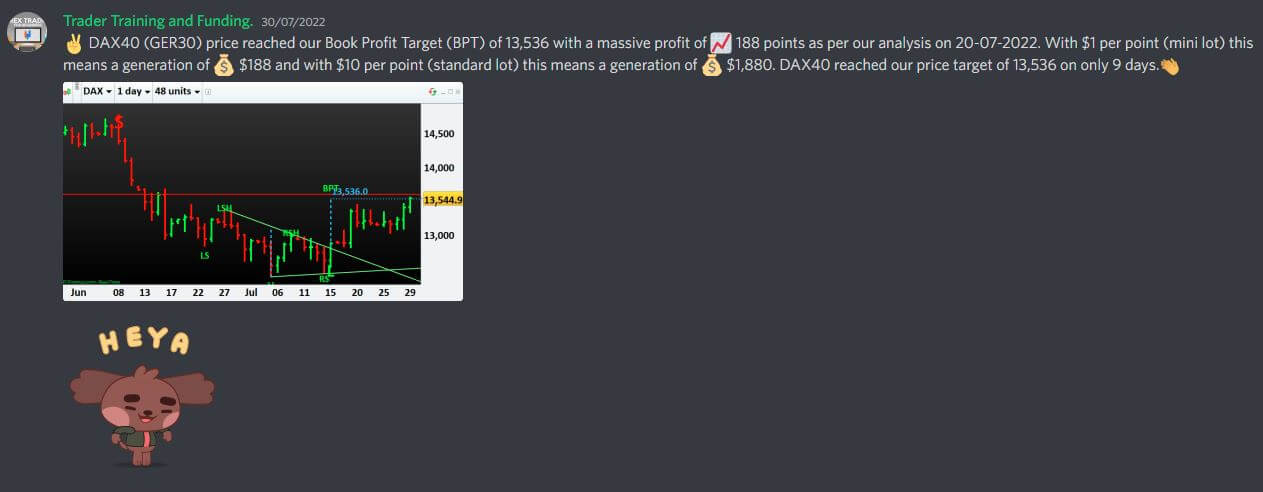
Our analysis for DAX40 (GER30) Index trades on 20.07.2022 on our Discord (https://discord.gg/5HkVUCk6KB) Index Trading Room, we wrote, “ Inverse Head and Shoulder (Head-Stand) can be observed for DAX40 (GER30) Index with Book Profit Target at 13,555” when DAX40 was trading at 13,348.
Exactly as per above analysis, DAX40 reached our set Profit Target with a gain of 207 points which is equivalent to $207 when invested $1 per point and $2,070 when invested $10 per point (standard lot).
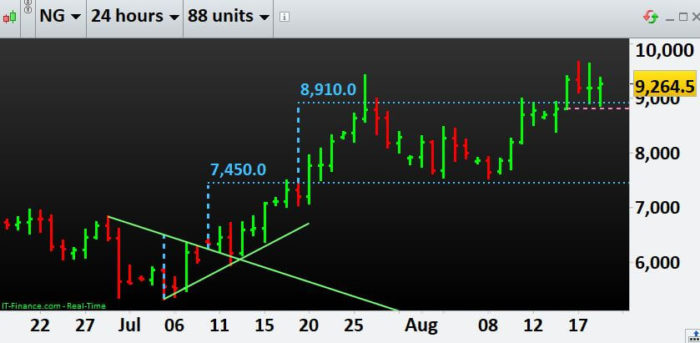
Our analysis for Natural Gas (NG) Commodity trades on 20.07.2022 on our Discord (https://discord.gg/5HkVUCk6KB) Commodity Trading Room: Inverse Head and Shoulder (Head-Stand) observed for NG (Natural Gas) Commodity reached it’s Book Profit Target at 7,450.00 in only 7 trading days with a massive gain of 1,190 points which is equivalent to $1,190 when invested $1 per point and $11,190 when invested $10 per point (standard lot).
The rest 4 instrument trades (AAPL shares, Spot Gold, Hangseng 50 (HK50)) did reach all their set profit targets resulting in a humongous total gain of 13,097 points in the last 1 month.
We have been achieving these types of successes for the last 7 years through our Proprietary Trading Strategies as demonstrated in our blog posts. You can also derive such profitable benefits when you are trained by us.
We are always there to support you, when you need it the most, either through Email, Live Chat, Landline phone, Mobile phone, WhatsApp, Messenger, SMS, Telegram and Discord.
Level 3, 2 Brandon Park Drive
Wheelers Hill, Victoria 3150
Phone: +61 3 9790 6476
email: [email protected]
Let’s chat https://discord.gg/5HkVUCk6KB
=================================================================================================================================
Our Blog Post dated 31.07.2022:
On 18.07.2022, we analysed the share price of Amazon when it was trading at 113.77.
In our analysis for the share price of Amazon in our paid Client Arena, we wrote, “An interesting inverse Head and Shoulder (Head-Stand) can be noticed in action in Amazon Inc Share’s Daily Price Pattern. The head swing low was plotted on 14.06.2022 with left shoulder plotted on 24.05.2022 and the right shoulder plotted on 30.06.2022.
The neckline angel can be approximately 29 degree downwards. Book Profit Target (BPT) from this inverse Head and Shoulder (Head Stand) for AMZN/USD can be at 136.36 if the price is crossing to the upside of 118.18 level”.
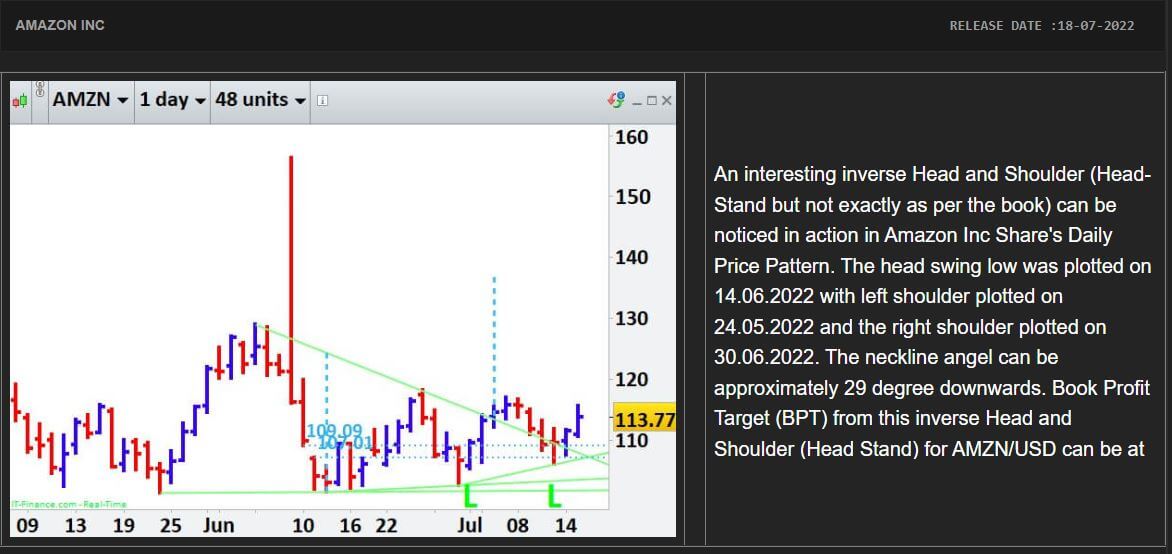
From 18-07-2022 to 29-07-2022, within only 10 days, Amazon share price reached our Book Profit Target (BPT) of 136.36 with a humongous profit of 2,259 points.
With $1 per point (mini lot) this means a generation of $2,259 and with $10 per point (standard lot) this means a generation of $22,590.
We have been achieving these types of successes for the last 7 years through our blog posts. You can also do the same.
We are always there to support you, when you need it the most, either through Email, Live Chat, Landline phone, Mobile phone, WhatsApp, Messenger, SMS, Telegram and Discord.
Level 3, 2 Brandon Park Drive
Wheelers Hill, Victoria 3150
Phone: +61 3 9790 6476
email: [email protected]
Let’s chat https://discord.gg/5HkVUCk6KB
=================================================================================================================================

3 Shares & 3 Indices have hit 10 set Profit Targets according to our Pattern Analysis in the last 8 days alone. In the dynamic

Mastering Market Analysis: Understanding Technical Patterns for Predicting Market Trends In the dynamic world of trading, mastering market trends through Pattern Analysis is the key
Pundits say Gold is overheated but Gold reached our 8th and 9th out of 10 set Profit Targets! In the thrilling arena of financial markets,

[vc_row][vc_column][vc_column_text]

[vc_row][vc_column][vc_column_text]
[vc_row][vc_column][vc_column_text]
[vc_row][vc_column][vc_column_text]
[vc_row][vc_column][vc_column_text]
[vc_row][vc_column][vc_column_text]
[vc_row][vc_column][vc_column_text]
[vc_row][vc_column][vc_column_text]
[vc_row][vc_column][vc_column_text]
[vc_row][vc_column][vc_column_text]